
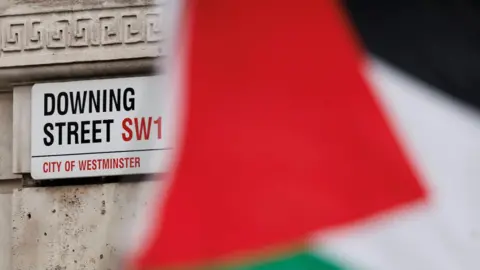

Story Highlight
– Emily Damari criticizes Starmer’s Palestinian state recognition plan.
– Damari warns it may prolong hostage situation.
– Hostage families express concerns about UK’s diplomatic shift.
– Labour MPs largely support recognizing Palestinian state soon.
– Government struggle with balancing political pressures and conditions.
Full Story
Sir Keir Starmer has received pointed criticism from Emily Damari, a British woman who was held hostage in Gaza for 15 months. Damari’s comments came in reaction to Starmer’s recent statement indicating his readiness to acknowledge a Palestinian state come September. She labelled this move a “moral failure,” suggesting it could “reward terror” and “prolong the conflict.”
Damari’s remarks align with concerns expressed by representatives of 10 hostages currently in Gaza or those who have been held there, who either have British nationality or strong connections to the UK. While the representatives abstained from commenting on the broader political dynamics, they expressed worry that the UK’s new stance could diminish the motivations for Hamas to agree to a ceasefire and release the hostages, a situation that could complicate any potential recognition of Palestinian statehood.
Concerns among the families stem from Starmer’s remarks following a meeting of the emergency cabinet, particularly regarding conditional UK recognition of a Palestinian state. He highlighted that this recognition would depend on Israel’s compliance with several criteria: agreeing to a ceasefire, committing to not annexing the West Bank, taking significant steps to alleviate the humanitarian crisis in Gaza, and engaging in a long-term peace initiative.
However, government sources have clarified that Starmer’s approach also takes into account the actions of Hamas. “Our message to the terrorists of Hamas is unchanged and unequivocal,” he stated. “They must immediately release all the hostages, sign up to a ceasefire, disarm and accept that they will play no part in the government of Gaza.” The Prime Minister indicated that the UK would assess the situation in September based on the actions of both Israel and Hamas.
Despite the government’s messaging, there has been inconsistency in how officials address this complexity. For instance, Transport Secretary Heidi Alexander emphasised that the Israeli government needed to fulfil its responsibilities when posed with questions about Hamas’s influence in Gaza by September. There is a widespread expectation among Labour members that the government will indeed move forward with recognising a Palestinian state.
This development marks a notable shift in the UK’s diplomatic stance compared to previous positions held by various governments. Starmer has expressed a desire to acknowledge a Palestinian state contingent upon it fostering a viable two-state solution. Until recently, this had seemed to imply that statehood recognition would wait until the conflict concluded.
The dynamics within the Labour Party have also played a key role in this evolving narrative. While Starmer’s rhetoric has been hardening, more than half of Labour MPs without government roles had signed a letter advocating for the recognition of a Palestinian state by the beginning of the week. Some ministers have hinted at their agreement with this view, suggesting that political pressures could render a vote on the issue unavoidable when Parliament reconvenes.
This situation presents the government with a balancing act, as opinions diverge within Labour and among opposition parties. Some advocate that Palestinian statehood should not be contingent upon the Israeli government’s actions, while others contend that it should remain on hold until hostages are released—despite the envisioned governance of a future Palestinian state being under the Palestinian Authority rather than Hamas.
Ultimately, the momentum for policy change has grown from within the Labour Party, where many members who have generally supported Starmer have now called for progress on this issue. This fragile consensus appears to lean towards an expectation of inevitable recognition of a Palestinian state in the near future.

