Story Highlight
– Apple appeals $1.5bn ruling overcharging UK customers.
– Campaigners see this as a shift against big tech.
– Class actions could lead to $6bn in compensation claims.
– Users demand fairer app store commissions, lower than 30%.
– Increased awareness of digital costs post-Covid emphasized.
Full Story
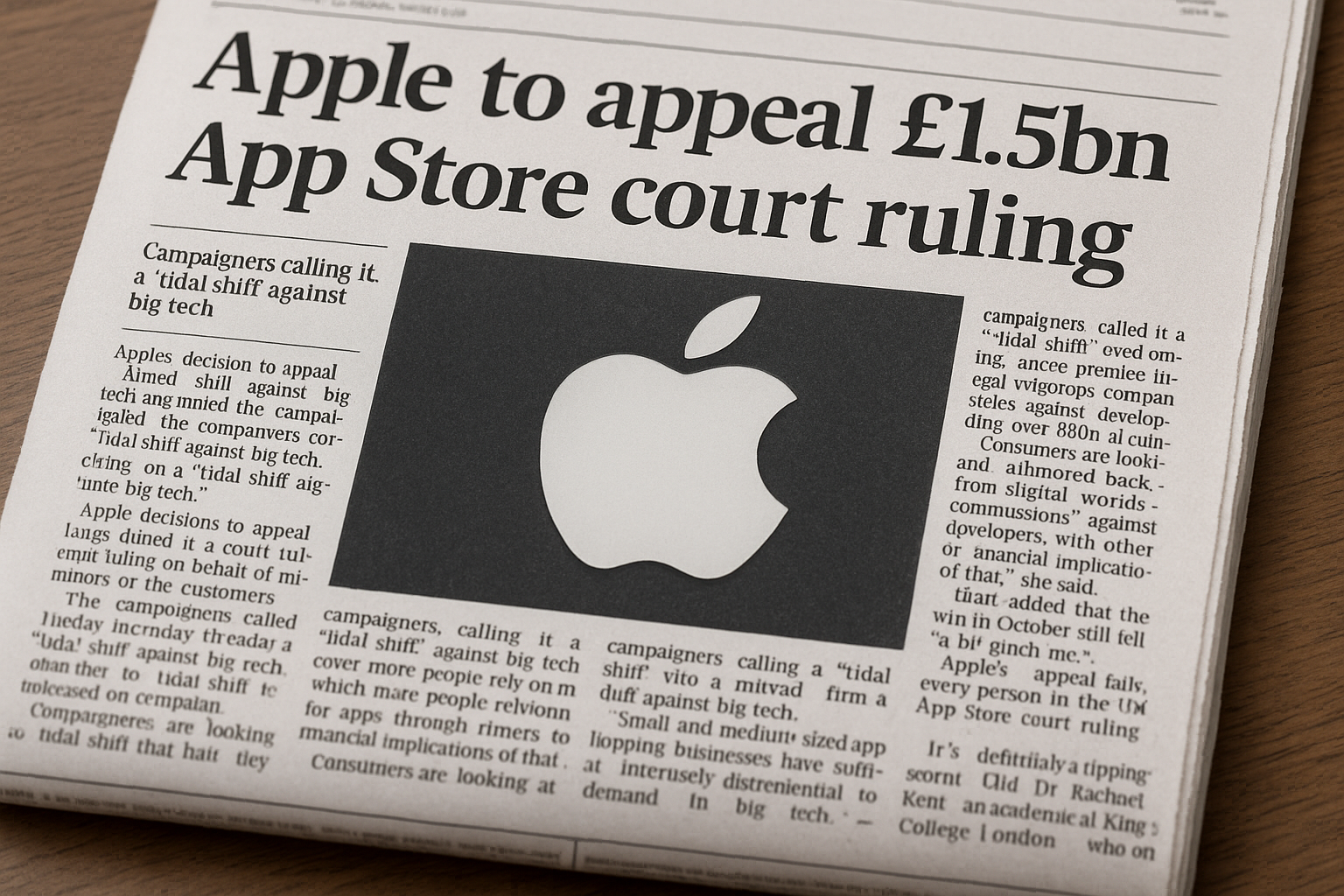
Apple is challenging a significant $1.5 billion court decision that ruled the company had excessively charged millions of UK customers through its App Store. The tech giant has taken steps to appeal the ruling, which has been hailed by advocates as a potential shift in the regulatory landscape for major technology firms.
This case is part of a broader series of legal actions set to commence in 2026, as consumers increasingly recognize the financial burden of commissions reaching up to 30%. Activists refer to this as the “Apple tax,” affecting those who rely on apps for diverse purposes such as fitness tracking and dating.
The appeal encompasses one of several class action lawsuits against both Apple and Google, where consumers, entrepreneurs, and small businesses are collectively seeking over $6 billion in damages. These class action lawsuits are structured as opt-out, allowing millions of individuals to join in claims regarding competition law violations.
Dr. Rachael Kent, an academic from King’s College London and the driving force behind the successful $1.5 billion case on behalf of 36 million UK consumers, remarked, “It’s definitely a tipping point.” She added that there is a growing public backlash against the negative impacts of digital environments, particularly concerning financial ramifications. Reflecting on the victory achieved in October, she noted, “It still feels a bit pinch me.” If the appeal does not succeed, it could entitle anyone in the UK who made App Store purchases from 2015 to 2024 to receive compensation.
Within these ongoing class action cases, Apple and Google face allegations of imposing excessive charges on UK consumers. The findings from the competition appeal tribunal indicated that instead of the current rates which can go up to 30%, Apple should implement a 17.5% commission for apps and a 10% charge for in-app purchases. Meanwhile, app developers are suggested to only pay 10%.
One notable lawsuit led by Barry Rodger, a law professor at the University of Strathclyde, represents over 2,000 app developers seeking up to $1 billion in compensation. Rodger claimed, “Small and medium-sized app developer businesses have suffered as the result of excessive profiteering by the App Store and Google Play,” pointing out that developers of dating and gaming apps are particularly impacted.
Rodger’s claim is set to be argued in the competition appeal tribunal during October 2026, working concurrently with another case representing 19 million Google Play customers, who are also alleged to be victims of unfair charges. Consumer advocate Liz Coll is spearheading this case, accusing Google of stifling competition and imposing unlawfully high commissions on digital transactions. Coll highlighted, “These types of large collective proceedings are new in the UK,” expressing enthusiasm over the potential implications of the Kent decision.
A spokesperson for Google stated, “Android provides more choice than any other platform and our fees are the lowest of any major app platform. We’ll defend these cases vigorously.” The company contends that the class action lawsuits aim to disrupt a framework it believes has led to lower costs and enhanced options for consumers, arguing that a setback could complicate app accessibility and security on Android devices.
In a broader context, the consumer advocacy group Which? has launched a $3 billion claim against Apple regarding its iCloud services, asserting that the company effectively coerces customers into using its platform. Apple has dismissed these allegations as baseless, asserting that users are not obligated to utilize iCloud services. The tech firm has also voiced strong disagreement with the Kent ruling, stating that it misrepresents the competitive status of the app market and emphasizes the role of the App Store in bolstering the UK’s digital economy, which it claims supports over $41 billion in sales.
Dr. Kent expressed her observations on rising public awareness regarding the drawbacks of digital technology. “There is a tidal shift that is happening against big tech,” she said. She pointed out that the pandemic has significantly increased reliance on technology, with many individuals shifting from using a few apps weekly to numerous applications daily for various tasks, leading to heightened public scrutiny of tech giants’ practices.