
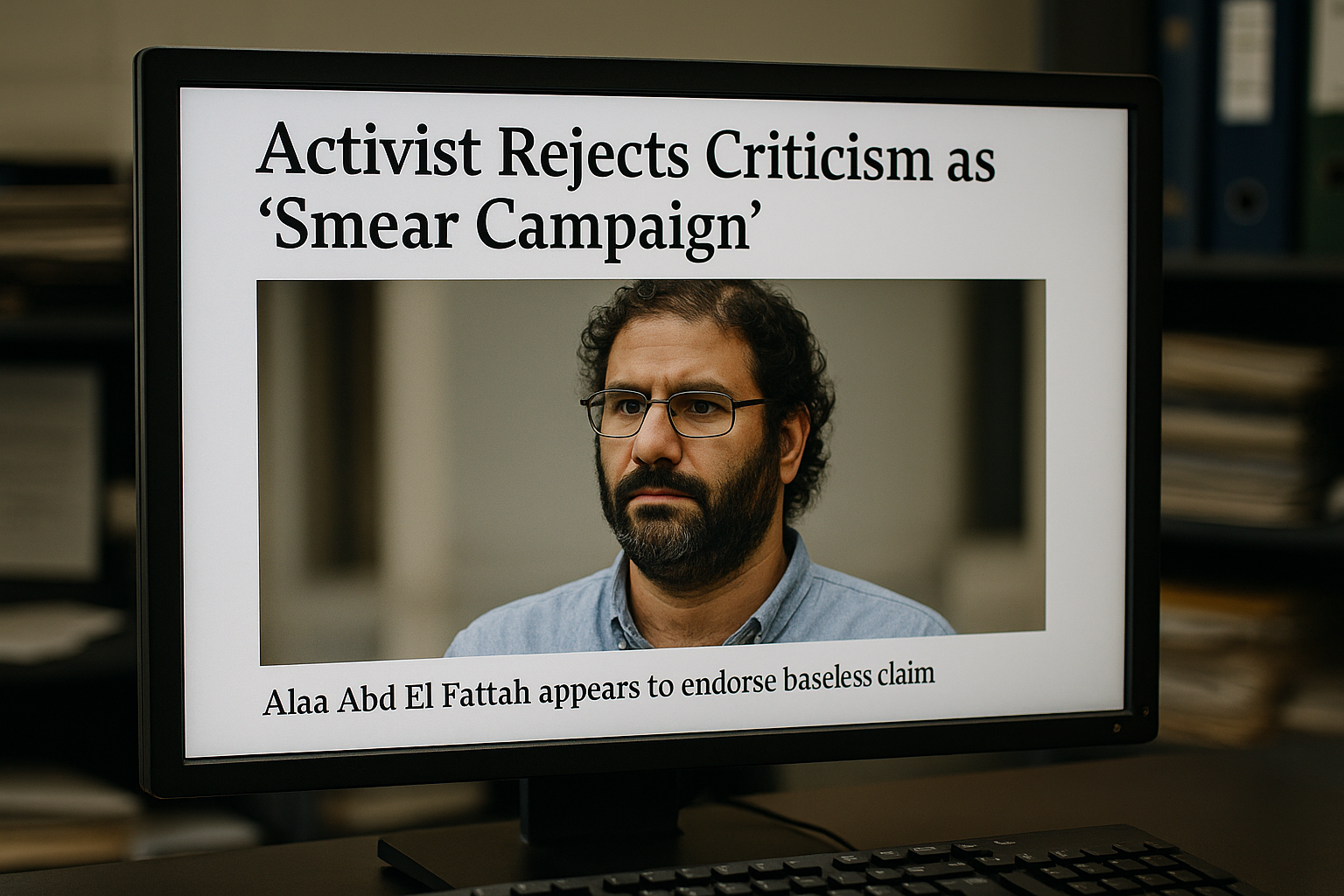
Story Highlight
– Alaa Abd El Fattah returned to the UK after 12 years.
– Old social media posts spark political controversy.
– Apology issued for past extremist comments.
– Criticism of his victim claims continues post-apology.
– Government reviewing information failures regarding his history.
Full Story
Alaa Abd El Fattah, the British-Egyptian activist recently released from an Egyptian prison, has seemingly supported controversial claims regarding a purported “smear campaign” against him. Abd El Fattah returned to the UK on Friday, reuniting with his family after a 12-year separation, during which human rights advocates asserted he had faced unjust imprisonment.
The Prime Minister acknowledged Abd El Fattah’s return in a post on social media platform X. However, the government faced backlash after resurfaced posts from Abd El Fattah emerged, in which he advocated violence against Zionists and police officers. Labour leader Sir Keir Starmer expressed surprise at the “absolutely abhorrent” nature of these comments, which Abd El Fattah has since denounced. Starmer confirmed the government is reviewing the information gaps related to this matter, stating, “With the rise of antisemitism, and recent horrific attacks, I know this has added to the distress of many in the Jewish community in the UK.”
Foreign Secretary Yvette Cooper has directed a senior official to investigate why both current and former government members were unaware of Abd El Fattah’s earlier remarks. In a statement issued early on Monday, Abd El Fattah apologized, recognizing the “shocking and hurtful” impact of his past comments, which he described as “expressions of a young man’s anger.” The Prime Minister’s spokesperson later regarded the apology as “fairly fulsome” and appropriate.
However, shortly after his apology, it was discovered that Abd El Fattah’s Facebook account had liked a post asserting that criticisms against him constitute a “relentless smear campaign” involving significant financial players and certain intelligence agencies. Additionally, Shadow Justice Secretary Robert Jenrick pointed to another liked post suggesting Abd El Fattah was a victim of a Zionist-led effort against him. Although BBC News has obtained a screenshot of this second post, the original has since been removed. Jenrick remarked that these actions indicate Abd El Fattah’s apology lacked sincerity, asserting that it rather highlights his continued alignment with extremist viewpoints.
He noted, “Far from distancing himself from his earlier extremist views, he confirms that he still holds them. Far from showing contrition, he is presenting himself as the victim of a conspiracy.” Jenrick went further to assert that these posts could potentially justify the revocation of Abd El Fattah’s British citizenship, describing him as a current threat to national security.
Abd El Fattah’s Facebook account previously showcased a heartwarming image of his reunion with his 14-year-old son, Khaled, upon his arrival in the UK. This activist first gained prominence during the 2011 protests that led to the ousting of Egyptian president Hosni Mubarak. In 2021, he was convicted for “spreading fake news” linked to a Facebook post addressing torture, a verdict widely condemned by human rights groups.
He was granted British citizenship in December 2021, a status achieved via his mother, who was born in London. Following the emergence of his older tweets, calls have intensified from the Conservative Party and Reform UK for the government to consider revoking his citizenship and expelling him from the UK. Although Home Office powers exist to strip a dual national of citizenship if deemed contrary to the public good, such actions have generally been reserved for cases involving terrorism or serious organized crime posing a national security risk.
Sources suggest that Downing Street believes this threshold has not been reached in Abd El Fattah’s case, and any decision to remove someone’s citizenship is likely to provoke a drawn-out and costly legal process. It is also noteworthy that Abd El Fattah was previously withdrawn from consideration for a human rights award a decade ago due to past comments he had made regarding Israel in 2012. Rail Minister Lord Hendy commended the government’s initiative to investigate the oversight of Abd El Fattah’s remarks, stating, “What he said was clearly quite abhorrent. Nobody would subscribe to that – certainly not the government.” He added the Foreign Office is now looking into why these tweets were not previously addressed.

