
Story Highlight
– Chen Liang founded Guchi Robotics in Shanghai, 2019.
– Guchi automates assembly for top Chinese car brands.
– China invests $100 billion in robotics and strategic technologies.
– Humanoid robots aim to replace factory workers globally.
– Teleoperators train robots, shifting workforce dynamics in China.
Full Story
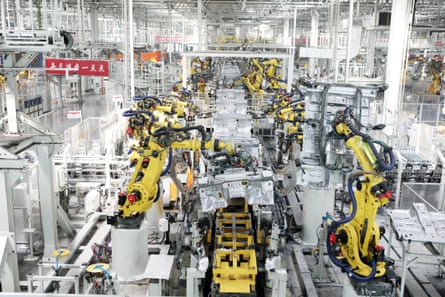
Chen Liang, a prominent figure in the field of automation, leads Guchi Robotics, an innovative company based in Shanghai. In his mid-40s, he presents a calm demeanor, but his enthusiasm shines through in discussions about his work, especially concerning the role of robots in assembly lines. Guchi specializes in automation technology, creating machines that seamlessly install wheels, dashboards, and windows for leading Chinese automotive brands such as BYD and Nio. The company’s name, derived from the Chinese term for “steadfast intelligence,” also carries a nod to the sound of an Italian luxury brand.
Over nearly two decades, Chen has focused on a critical engineering challenge: the automation of tasks in car manufacturing to reduce human labor. Guchi, established in 2019, aims to revolutionize the final assembly stage of production, where various components are integrated into vehicles. Currently, Chen’s robots can autonomously handle essential tasks, though he estimates that around 80% of final assembly remains reliant on human intervention.
In China, the integration of artificial intelligence (AI) into everyday life is growing, but the significant interest from policymakers and industry leaders lies in advancements in robotics. The current surge in robotics is heavily fueled by deep learning technology, similar to that which underpins popular AI models like ChatGPT. Experts envision a future where machines, akin to humans in their capabilities, can perform factory work, potentially replacing millions of positions globally.
China’s commitment to developing strategic technologies, including robotics, is evident in the establishment of a $100 billion fund aimed at fostering innovations in this sector. Nearby cities have also invested significantly in robotics initiatives, with over 140 companies competing to develop humanoid robots. Notably, some of these advancements were showcased during a high-profile Lunar New Year gala, where robots captivated millions with their performances.
Exploring the landscape of robotics in China, I visited multiple companies across five cities and witnessed a collective ambition to commercialize robotics for industrial applications. One notable interaction took place within a Guchi Robotics warehouse, where employees from General Motors were assessing Guchi’s robotic wheel-installation systems. The team, aiming to enhance production efficiency, had opted for Guchi over competitors for its ability to integrate into their moving assembly line, resulting in the potential reduction of assembly jobs in their North American plants.
Chen shared insights on the realities of the industry, noting that both Chinese and American engineers possess comparable skills, yet their approaches differ primarily in terms of resources and speed. During a tour of the warehouse, he pointed out the robotic arms designed for precise tasks, emphasizing the inevitability of automation in modern manufacturing processes.
In a later meeting with Galbot, a rising player in humanoid robotics, Chen examined the potential for deploying robots in complex manufacturing environments. Galbot’s approach involves developing robots for repetitive tasks, which have already been implemented in several Chinese factories. The founder, Wang He, mentioned ambitions to scale up operations and develop robots capable of handling various retail and industrial functions.
This increasing reliance on technology poses social challenges, particularly concerning the future of the workforce. Chen acknowledged that as automation becomes more prevalent, the necessity for retraining employees will arise, particularly for those in lower-skilled positions. This issue is further complicated by youthful disinterest in factory jobs, as many young people in China seek alternative career paths.
While the future of humanoid robots may still seem like a distant prospect, ongoing developments reveal the sector’s rapid evolution. The introduction of new artificial intelligence methods shows promise in enabling machines to operate in unpredictable environments, mimicking human adaptability.
During visits to other robotics companies, I noted the rising importance of teleoperations in training robots. Employees work alongside machines, guiding them through tasks and capturing data that refines their abilities. Yet, the nature of the work appears dehumanizing to some, reminiscent of lab work rather than traditional factory roles.
As China accelerates its technological advancements, governmental support for robotics firms illustrates a strategic commitment to leading global automation efforts. Municipalities actively encourage local startups, with many offering significant resources to nurture and promote these burgeoning industries.
Although some experts voice skepticism regarding the current pace of robotic innovation, Chen remains optimistic. His vision extends towards a future where automation alleviates labor-intensive roles while creating new opportunities for skilled workers, fundamentally reshaping the landscape of manufacturing in China.