
Story Highlight
– UK and US engaged in ongoing tech deal negotiations.
– Talks stalled over US concerns regarding UK trade barriers.
– Both countries aim to collaborate on AI and quantum computing.
– £31bn investment planned by major US tech firms in UK.
– Proposed tech deal dependent on wider US-UK Economic Prosperity progress.
Full Story
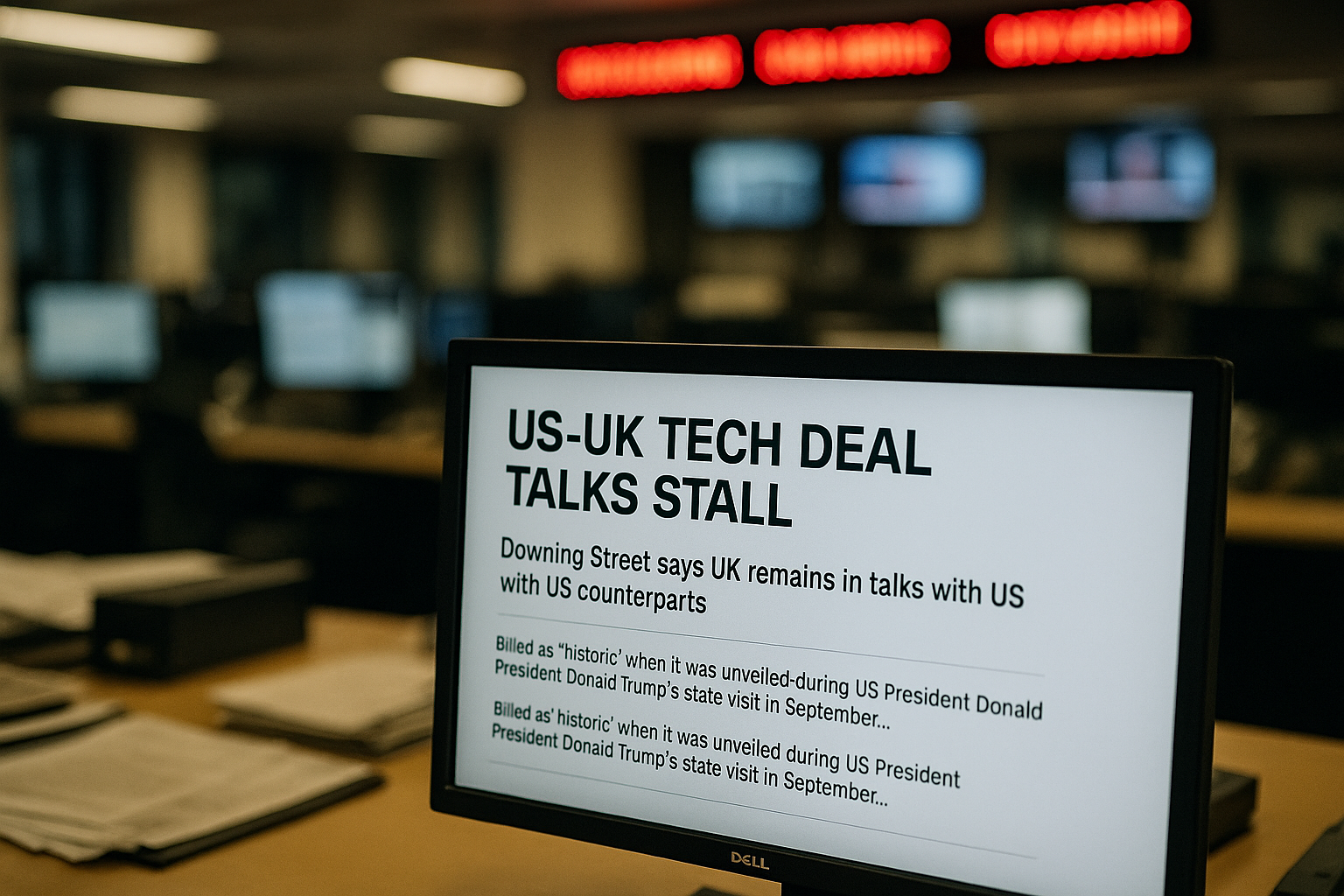
The UK government is engaged in ongoing discussions with US officials regarding a comprehensive technology agreement, referred to as the Technology Prosperity Deal. According to sources, these talks have encountered challenges due to US apprehensions concerning perceived trade obstacles posed by the UK.
Initially described as a “historic” collaboration during the state visit of former US President Donald Trump in September, the deal aims to enhance cooperation in notable areas such as artificial intelligence (AI) and quantum computing. A spokesperson for the Prime Minister expressed optimism about finalizing an agreement that is expected to benefit millions on both sides of the Atlantic. However, the spokesperson refrained from providing specific comments on the ongoing negotiations, acknowledging that such discussions often face complexities.
The New York Times highlighted the existence of broader disputes between the UK and US, particularly concerning digital regulations and food safety standards. The UK government has not addressed these allegations directly, and the White House has not responded to requests for comments.
Michael Kratsios, a science adviser under the Trump administration, stated that the US hopes to reinvigorate discussions surrounding the deal. He noted on the social media platform X, “In line with Section III of the US-UK Technology Prosperity Deal, we hope to resume work with the United Kingdom once the UK has made substantial progress in implementing its commitments under the Economic Prosperity Deal. We look forward to continuing our productive collaboration across AI, quantum, nuclear, and other critical technology areas under the Deal.”
When the Technology Prosperity Deal was announced, government officials emphasized its potential benefits. Prime Minister Sir Keir Starmer remarked that it signifies a transformative step in the UK’s relationship with the US. Meanwhile, Technology Secretary Liz Kendall suggested the partnership represents a significant endorsement of Britain’s growing AI sector.
Coinciding with the announcement of the deal, several prominent US technology companies revealed substantial investments in the UK, amounting to £31 billion from firms such as Microsoft, Nvidia, and Google. It is believed that these planned investments remain unaffected by the current negotiations.
Nvidia’s CEO, Jensen Huang, expressed in September that the company’s commitment to the UK is driven by his vision of the country emerging as an “AI superpower,” a goal that aligns with the ambitions of the UK government. The investments are intended to bolster AI infrastructure, including data centers throughout the UK.
The agreement is outlined in a Memorandum of Understanding (MOU) that establishes a framework for collaboration in AI, quantum computing, and nuclear technology. While the MOU indicates intentions to work on advanced technologies, it also clarifies that these proposals are non-binding and contingent upon significant progress being made to actualize the broader Economic Prosperity Deal, which was signed in May.
The Trump administration has adopted a strategy to reshape global trade regulations, imposing tariffs on various nations, including allies like the UK, while pursuing deals it deems fairer to the US. For the UK, this has involved negotiations across multiple sectors, resulting in agreements related to the automotive industry and, more recently, pharmaceuticals. However, negotiations aimed at eliminating tariffs on UK steel exports to the US are reportedly on indefinite hold.
Allie Renison, director of communications firm SEC Newgate UK and a former government trade adviser, stated that the current standstill in technology negotiations reflects the US and UK’s fragmented approach to trade agreements. She observed that rather than pursuing a comprehensive trade agreement, different sectors are being discussed in isolation, which may impact technology negotiations. Despite uncertainties surrounding the implications for US tech companies’ investments in the UK, Ms. Renison suggested that the present situation is likely more about “posturing in the wider negotiations.”