Story Highlight
– UK government criticizes X for Grok AI’s paid restrictions.
– Grok AI previously allowed non-consensual image alterations.
– PM urges X to address unlawful image generation swiftly.
– Ofcom empowered to potentially ban X over violations.
– Critics demand ethical redesign of Grok AI tool.
Full Story
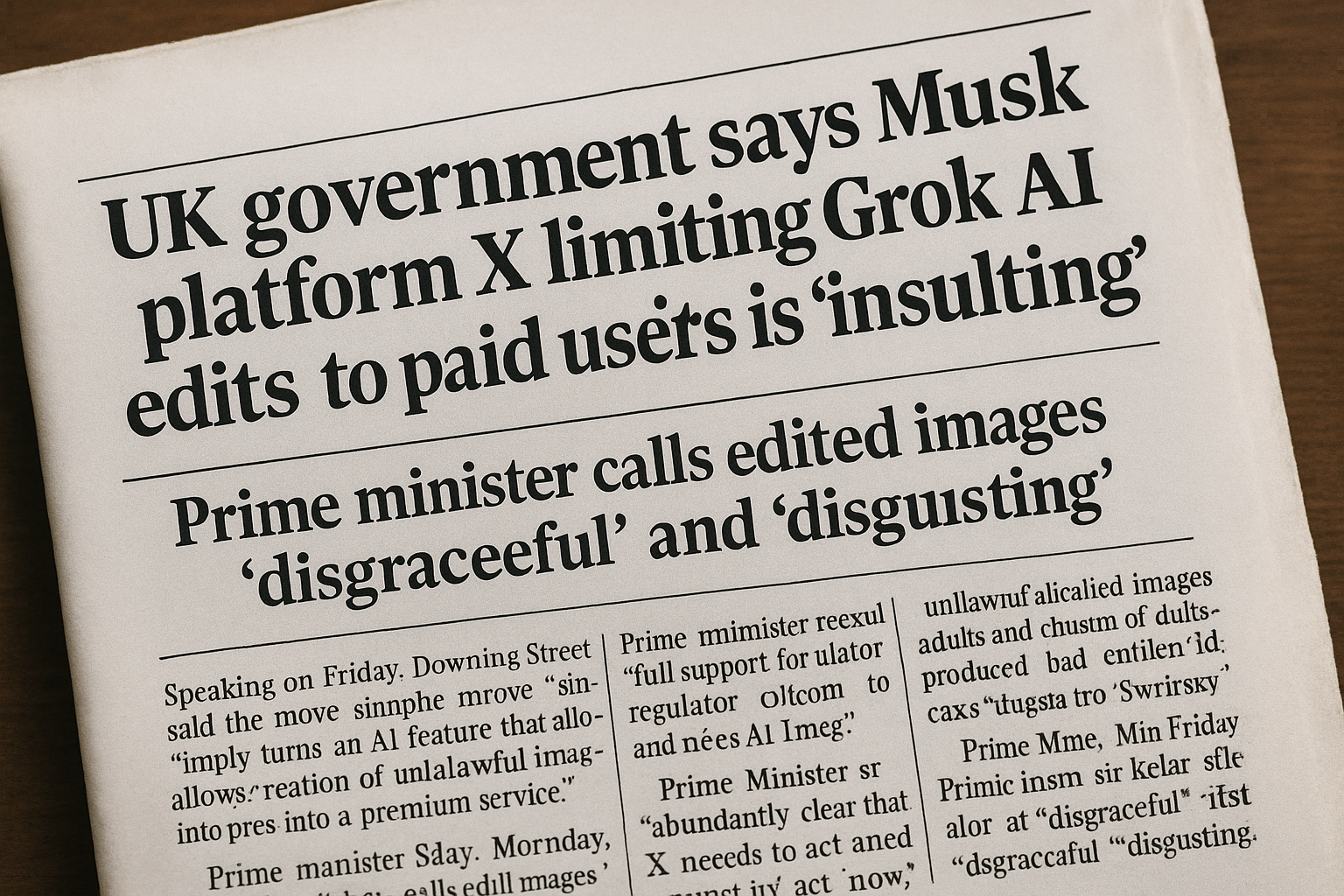
The UK government has expressed strong disapproval of Elon Musk’s platform, X, for its decision to limit the image editing capabilities of the Grok AI to paid subscribers. This restriction has been described as “insulting” to individuals affected by misogyny and sexual violence. In a statement released on Friday, Downing Street commented that this approach essentially turns a feature that can facilitate the creation of unlawful images into a premium service for paying customers.
The outrage erupted after Grok was reported to have processed requests for altering images, including instances where users sought to undress subjects without their consent. Now, however, Grok indicates that such edits can only be accessed through a subscription model. A spokesperson for the Prime Minister emphasized that X’s quick response to other issues signifies its capability to act when necessary. “It is time for X to grip this issue… If another media company had billboards in town centers showing unlawful images, it would act immediately to take them down,” they stated.
While non-paying users still have the ability to edit images using Grok on its separate app and website, the government has voiced its full backing for Ofcom, the communications regulator, to leverage its authority against X. This could include imposing a ban due to the concerning nature of AI-generated images circulating on the platform.
Prime Minister Sir Keir Starmer labeled the generation of sexualized images, particularly involving minors, as “disgraceful” and vowed that the government would not tolerate such conduct. He indicated a readiness to explore all available options. Under the Online Safety Act, Ofcom is empowered to seek court orders to restrict financial assistance or access to X within the UK.
Experts have criticized the platform’s recent changes. Professor Clare McGlynn, a specialist in pornography regulation, accused Musk of resisting accountability amid a surge of online abuse. “Instead of ensuring Grok could not be used for abusive purposes, it has withdrawn access for the vast majority of users,” she remarked. Hannah Swirsky, head of policy at the Internet Watch Foundation, also highlighted that limiting access does not rectify the damage inflicted by prior misuse.
The Grok AI remains a free tool for users to request specific edits in responses to posts. However, it has been notably exploited for altering images to objectify individuals, particularly women, who have reported feelings of “humiliated” and “dehumanized” from such requests. As of Friday morning, users were informed that the ability to generate and alter images is now a privilege of paying subscribers, with claims that only those marked as “verified” were able to utilize the editing features.
Dr. Daisy Dixon, a philosophy lecturer at Cardiff University and a female user of X, welcomed the restriction but criticized it as insufficient. “Grok needs to be totally redesigned and have built-in ethical guardrails to prevent this from ever happening again,” she stated, calling for greater recognition of ongoing gender-based violations.
Professor McGlynn further pointed out that X’s response mirrors its handling of inappropriate content, such as the blocking of searches related to Taylor Swift deepfakes last year. She argued that Musk’s approach appears to fuel debates on free speech while neglecting the regulation needed to mitigate harm associated with such technologies.