
Story Highlight
– UK porn site visits dropped significantly post age checks.
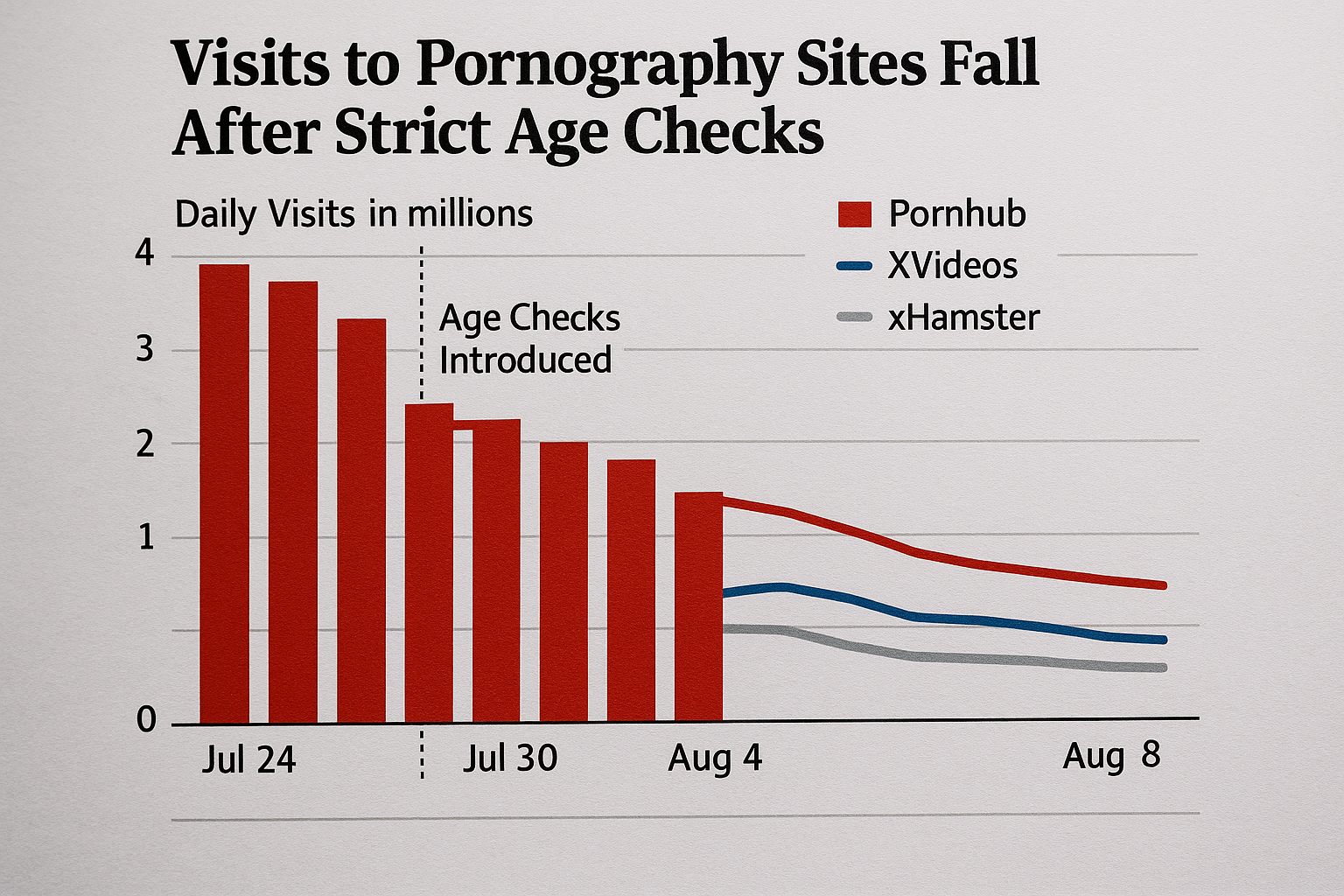
– Pornhub’s traffic fell from 3.6m to 1.9m visits.
– Social media sites didn’t experience similar traffic declines.
– Age verification methods include facial estimation and ID checks.
– VPN downloads surged to bypass new restrictions.
Full Story
Following the implementation of stringent age verification measures last month, traffic to pornography websites in the UK has seen a significant decline, according to recent data. On July 24, prior to the introduction of these age checks, Pornhub recorded approximately 3.6 million daily visits, but by August 8, this figure had plummeted to about 1.9 million—a drop of 47%. Similar trends were noted on other popular sites, including XVideos and xHamster, which experienced declines of 47% and 39% respectively.
This downturn appears to correlate with the enforcement of age-gating rules introduced on July 25 under the Online Safety Act. However, it is noteworthy that social media platforms such as X (formerly Twitter) and Reddit, which also began using age verification for content unsuitable for those under 18, did not show a corresponding decrease in user traffic.
A representative from Pornhub commented, “As we’ve seen in many jurisdictions around the world, there is often a drop in traffic for compliant sites and an increase in traffic for non-compliant sites.” The Online Safety Act aims to shield minors from harmful content, mandating that websites displaying pornographic material implement measures to restrict access by underage users.
Ofcom, the regulatory body in charge of overseeing these regulations, supports several methods of age verification. These include facial age estimation, which uses live imagery to determine a person’s age; age verification through financial institutions; photo ID verification, matching government-issued identification with a live selfie; and the use of digital identity wallets to verify age.
In addition to regulating adult content, the act also encompasses restrictions on other harmful materials, such as content promoting self-harm or suicide, and prohibits the circulation of dangerous challenges or violent incitements. This broad scope has raised concerns about excessive regulation, as seen with the age-gating of supportive forums related to alcohol recovery and content surrounding anti-migrant protests.
While Ofcom asserts that the legislation upholds free expression, it warns that violations may lead to various penalties, including fines reaching £18 million or 10% of a company’s global turnover, and in severe cases, complete removal from the UK market.
In a related political development, the Reform UK party, led by Nigel Farage, has expressed intentions to repeal the Online Safety Act, igniting a contentious exchange with the current technology secretary, Peter Kyle. Kyle accused Farage of aligning with individuals associated with past scandals, which Farage denounced as a personal attack.
The enforcement of age checks has also prompted a rise in the use of virtual private networks (VPNs), which allow users to bypass geographic restrictions on site access. Notably, several VPN applications have dominated the top spots in Apple’s app store in recent weeks.