
Story Highlight
– Mehdi Hasan went viral after a YouTube debate.
– Debate featured far-right extremists and controversial statements.
– Jubilee Media’s “Surrounded” gained over 10 million views.
– Criticism exists over content extremes and viewer engagement.
– Hasan reflects on debate’s impact and future value.
Full Story
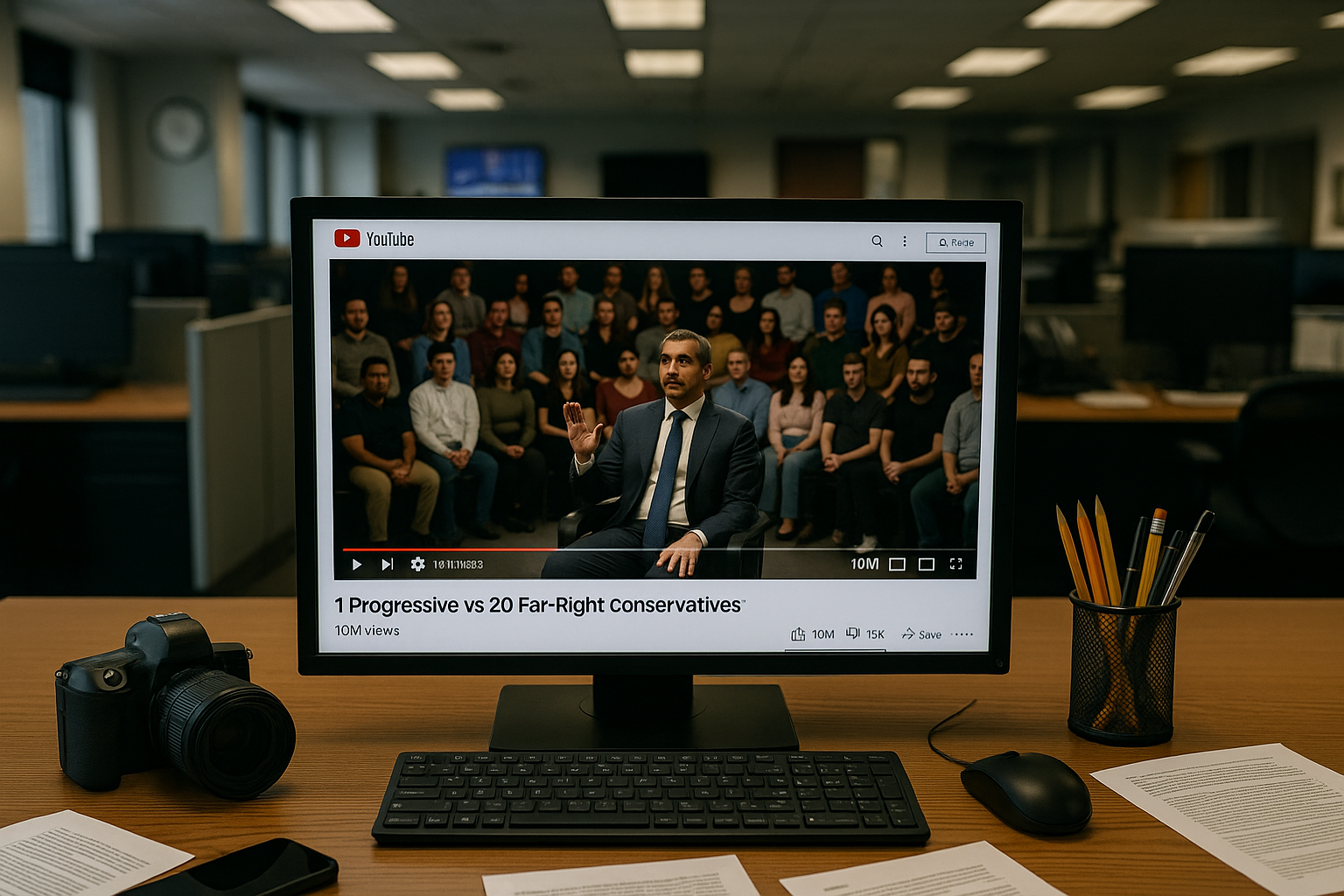
Mehdi Hasan has found himself at the center of an online sensation. The British-American commentator, author, and broadcaster noted a sharp rise in his YouTube views and an influx of notifications on his phone. However, the moment that truly encapsulated his newfound fame occurred at a Washington event when an older gentleman approached him and, speaking in Urdu, remarked: “I watched you with the 20 crazies.” This comment referred to Hasan’s participation in the online debate series Surrounded, which featured him taking on 20 far-right conservatives and is hosted by Jubilee Media.
During the contentious debate—titled “1 Progressive vs 20 Far-Right Conservatives”—Hasan was questioned about his ethnic origins by a participant who was later revealed by the Guardian to be involved in organizing violent far-right protests. Another debater, who was subsequently dismissed and condemned for his comments, openly embraced his fascist beliefs, later garnering $30,000 (£22,300) in support through a Christian crowdfunding platform. The debate itself has amassed over 10 million views, showcasing the polarizing nature of its content.
Hasan expressed surprise at the level of engagement the debate generated, observing, “I saw the massive audience it gets with young people. I thought, well, that’s a good place to be. But it’s really cut through in a way even I didn’t imagine – it’s been phenomenal for both good reasons and bad.” Following the debate’s success, he launched Zeteo, an alternative news platform, aiming to carve out a space amidst the digital chaos.
Founded in 2017, Jubilee Media has seen rapid growth, appealing especially to younger audiences by turning contentious discussions into shareable snippets. Although the company produces various content, Surrounded remains its most infamous offering, where one expert faces a panel of opponents vying for a chance to speak on critical political issues.
In recent months, Surrounded has tackled topics that traditional media often avoid, with notable episodes such as “Flat Earthers vs Scientists: Can We Trust Science?” and “Can 25 Liberal College Students Outsmart 1 Conservative? (Feat. Charlie Kirk)”, garnering millions of views. A recent debate featuring Ben Shapiro also became one of YouTube’s top election-related videos.
Jason Y Lee, Jubilee’s founder and CEO, initially launched the company as a non-profit in 2010 after a charity busking video. He articulated a vision for Jubilee as an entity that showcases ideal discourse, potentially becoming the “Disney for empathy.” However, the implications of their combative format raise questions regarding the very essence of empathy they aim to promote.
Media analyst Spencer Kornhaber remarked that while Jubilee’s aspirations toward empathy may be earnest, they are intertwined with commercial ambitions. He noted, “Empathy, in the Jubilee context, is standing for voyeurism and curiosity about other human beings.”
According to Julia Alexander, a media correspondent, Jubilee has ridden the wave of a growing free-speech mentality online, but risks aligning itself too closely with aggressive discourse. She warned, “They’ll have no choice but to continue doing more of these types of videos and just get more extreme,” given their pursuit of viewer engagement driven by controversy.
Hasan, who also contributes to the Guardian, acknowledges the allure of the provocative content produced by Jubilee, citing a failure of traditional media to facilitate productive discussions. He articulated, “Mainstream media did such a shit job of facilitating debate and discussion,” and laid emphasis on the need for balance in presenting varied opinions.
He has faced scrutiny for participating in Surrounded, with disability rights advocate Imani Barbarin highlighting the meme-driven distortion of political moments. Barbarin expressed concern that the necessary context of such debates is often lost in virally shareable clips, saying, “Those moments are quite literally being plucked out of space and time.”
Reflecting on his experience, Hasan admitted that he wished he had better understood the backgrounds of his opponents, although he remains conflicted about his overall participation. “I stand by what I said. I think I did a fair enough job as a debater,” he stated, adding, “The bigger meta question is whether the format itself is a problem. Is there value in doing these debates? And I don’t know the answer to that: maybe ask me in five years.”