Oxford Street cycling breaches and taxi delays follow traffic ban
Cyclists have ridden through Oxford Street’s new pedestrian zone, while taxi drivers say displaced traffic is making journeys through central London longer.

By Robert Aldridge, Senior Reporter
Published 30 Oct 2026, 07:00
What happened
Cyclists have continued riding through Oxford Street’s new pedestrian zone in the first days of a scheme backed by London mayor Sadiq Khan, while black cab drivers have raised concerns about congestion on surrounding roads. The changes have brought two immediate challenges: keeping the shopping street clear of moving vehicles and accommodating displaced traffic nearby.
The restrictions began on Monday morning and cover a 0.9km section stretching from Selfridges to Ikea. Cars, buses, taxis and bicycles are barred from travelling along that section. The bicycle restriction means the newly available road space is for pedestrians, rather than an additional route for people cycling through central London.
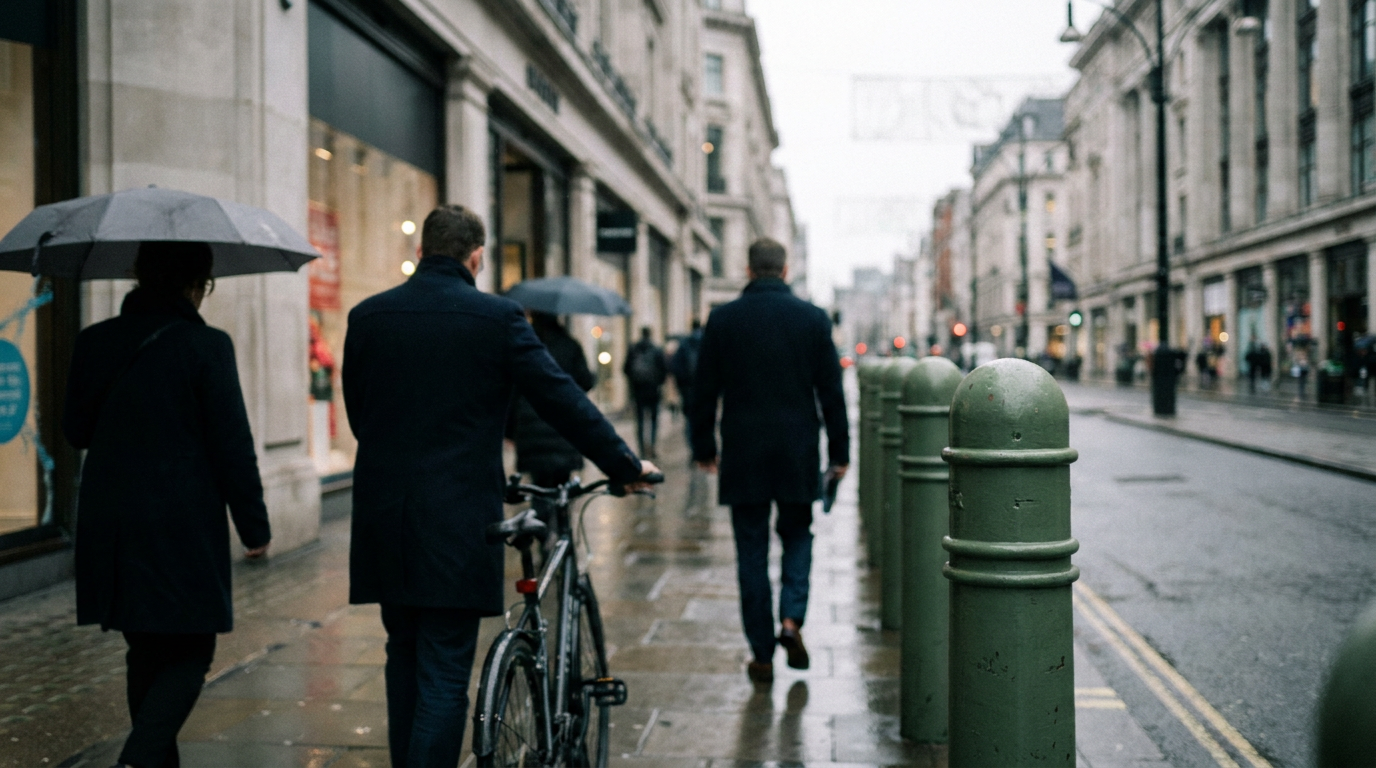
Green bollards were installed at either end of the zone overnight before the launch. Signs instructed cyclists to get off their bicycles and push them through the pedestrianised section. People arriving with a bicycle can therefore continue on foot, but riding along the closed stretch breaches the new rules.
Security guards were stationed at the entrances on the first day, telling riders to dismount. Compliance was mixed: by mid-morning, some cyclists were still passing through the bollards and continuing along the road. Their presence showed that the physical measures closing the street to motor traffic did not themselves stop bicycles entering.
An evening video showed dozens of cyclists moving through the pedestrianised area among shoppers. The group had assembled at one of the crossings where cars can still travel across Oxford Street. Although the scheme prevents vehicles travelling along the closed section, it retains those crossing movements through the pedestrian zone.
In the footage, a security guard stood near the bollards with his arms extended as riders passed. Other scenes from the opening days showed cyclists continuing over a large green marking laid on the road surface. The signs, road markings and staff instructions had not secured consistent observance of the cycling restriction.
The background
Khan’s proposal presents pedestrianisation as a change to the way people use one of central London’s principal shopping streets. Promotional illustrations depicted shoppers walking among trees and looking at shop windows. That vision places walking and shopping at the centre of a space previously also used for journeys by bus, taxi, car and bicycle.
Diagrams accompanying the plans showed traffic and buses using surrounding roads after the closure. Redirecting those journeys is a separate part of the change from managing the pedestrian space itself: vehicles excluded from the closed stretch must use other streets when travelling through the area, rather than continuing along their former route.
The distinction matters because the Oxford Street restrictions affect several types of transport at once. Bus passengers, taxi customers and drivers making through-journeys depend on the surrounding network, while shoppers within the zone experience the changes at street level. A clear road inside the pedestrianised area does not describe traffic conditions outside it.
Residents had raised concerns about congestion on neighbouring streets before the closure. During the opening week, video from Wigmore Street showed cars and buses stationary in queues. That provided a visible example of the pressure nearby, alongside drivers’ accounts of slower journeys elsewhere around the newly restricted section.
Regent Street is another focus of those accounts. Bahrain Mujagata, a 21-year-old London black cab driver, described particularly heavy northbound traffic there after the Oxford Street closure. He said the change had removed a route he previously used to avoid queues, leaving him sitting in traffic he could once bypass.
What people are saying
Mujagata described the effect on his working day as an immediate one. His criticism centred on the practical business of moving through central London: knowing an alternative route is less useful when that route is no longer open to taxis. He said the surrounding congestion was making his job harder.
He also identified features of northbound Regent Street that limit drivers’ room to manoeuvre. A cycle lane runs on the left and a central reservation separates traffic. In the conditions he described, a bus stopping to collect passengers leaves vehicles behind it waiting, rather than able to move past and continue.
The driver’s experience included traffic at night. That prompted concern about how the same streets would cope during the day, rather than an account from him of daytime conditions. His comments reflect the difficulty of judging a route’s usefulness simply by its availability: an open alternative can still involve a substantial wait.
Other black cab drivers have said journeys through central London are taking an additional 20 minutes. That figure is their assessment of the disruption, not a fixed addition to every taxi trip. The practical effect described is longer time spent completing journeys after the removal of Oxford Street as a through-route.
Mujagata did not reject pedestrianisation in principle. He objected to the way this scheme was working and said drivers would adapt, as they do when roads or permitted turns change. His position separates support for giving pedestrians more space from approval of the arrangements used to achieve it.
Khan attended Oxford Street at dawn on Monday to mark the start of the restrictions. The launch placed the mayor directly alongside a project intended to change the street’s character. The early criticism, by contrast, has concentrated on how the arrangements function in daily use, both at the entrances and beyond the closure.
What happens next
For cyclists approaching the zone, the instruction is to dismount and walk their bicycles through it. Following that instruction allows them to pass through without riding among shoppers. The distinction is straightforward but important: excluding cycling does not mean excluding someone who is on foot and pushing a bicycle.
Drivers using the area must now plan around the closed section rather than treat it as an available through-route. Mujagata’s expectation that cab drivers will adjust describes a process of learning how changed routes work in practice, including where queues form and how much time alternative journeys take.
At the vehicle crossings, pedestrians will continue to encounter traffic passing across the shopping street. Those retained crossings make the layout different from a wholly traffic-free space. Walking along the pedestrianised section and crossing one of the remaining vehicle routes involve different conditions, despite both being within the same wider scheme.
Why this matters
For people visiting Oxford Street, the immediate change is more space reserved for walking along the 0.9km stretch, but cyclists ignoring the restriction are still entering that space. Shoppers must also distinguish the closed roadway from the crossings that remain open to vehicles.
For taxi customers and others travelling through central London, the consequences extend beyond the shopping destination itself. Drivers’ accounts of longer journeys and the queues seen on Wigmore Street show why a pedestrian scheme also affects people whose destination lies elsewhere: their route through the surrounding area has changed.
Reporting that informed this story
This article was written independently by The Daily Times from publicly available facts and headlines. No text has been copied from the outlets above.