Man dies after tiger attack at Yorkshire Wildlife Park
A man died after entering a tiger enclosure at the park near Doncaster on Saturday, prompting an evacuation and closure through Sunday.

By Robert Aldridge, Senior Reporter
Published 10 Oct 2026, 18:00
What happened
A man has died after entering a tiger enclosure at Yorkshire Wildlife Park near Doncaster and being attacked by one of the animals. Emergency crews attended the attraction on Saturday afternoon, 10 October, but medical staff were unable to save him.
South Yorkshire Police said the man suffered serious injuries and was pronounced dead at the scene. His family has been informed, and specialist officers are supporting them. Police have not named him.
Yorkshire Ambulance Service received the emergency call at 1.33pm. Its response included two land ambulances, the Yorkshire Air Ambulance and a doctor, bringing medical teams to the park by road and air.
Police received a report of a man entering the enclosure at 1.35pm. The tiger attacked him after he went inside. Video recorded by visitors captured the man within the enclosed area and parts of the attack.
The tiger stayed inside its enclosure after the incident and was uninjured. Police said there was no wider danger to the public. The emergency response therefore took place around an animal that remained within the park's containment area.
Staff evacuated visitors and the attraction closed for the remainder of Saturday. The park also announced that it would not open on Sunday, 11 October, extending the closure into the second day of the weekend.
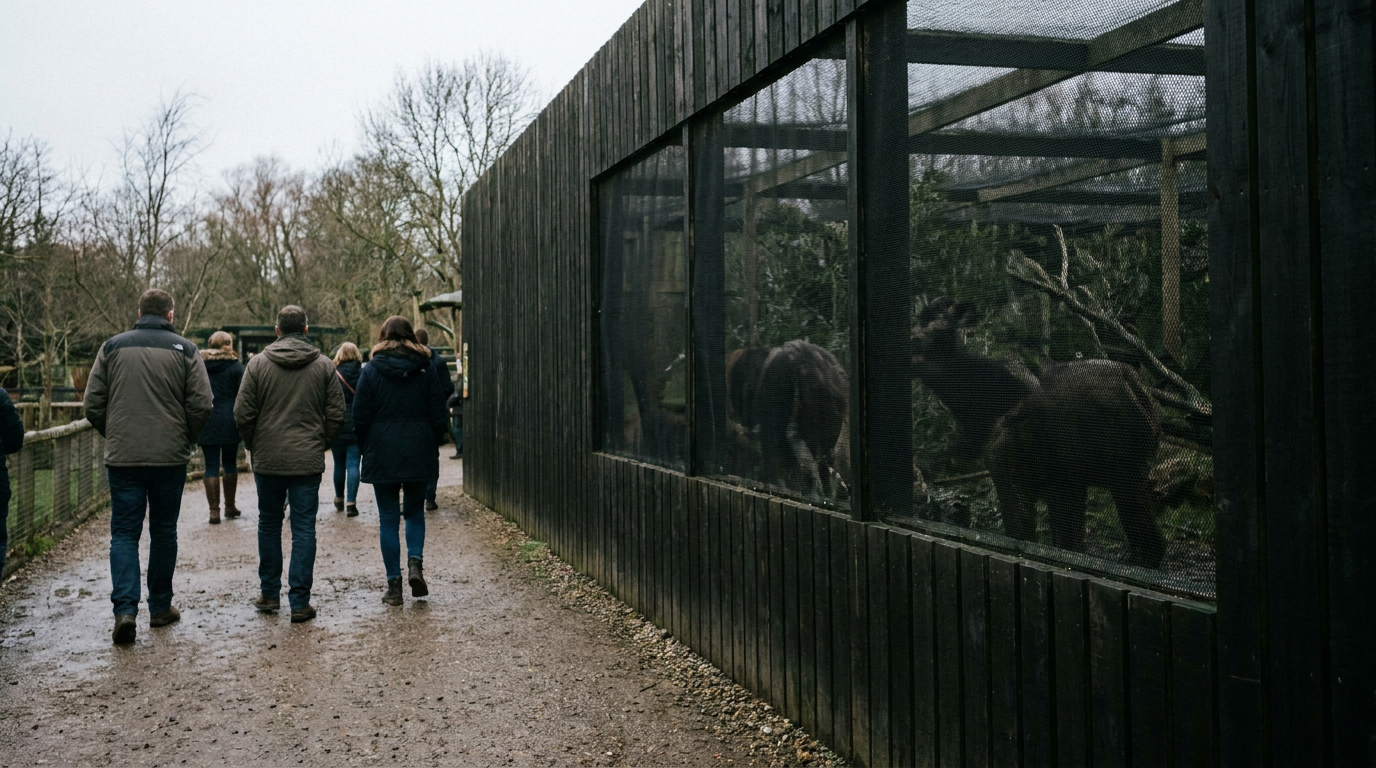
Black screening was put up around the tiger enclosure. A walkway between that area and the exit was closed during the response, affecting the route used by people leaving the attraction.
The background
The park has two Amur tigers: a female named Tschuna and a male named Altai. Tschuna weighs about 17 stone. Altai arrived in March last year, joining the collection before this weekend's incident.
Amur tigers are also commonly called Siberian tigers. Their natural range is in north-east Asia, principally the Russian Far East, with animals also found in north-east China. They are large predators adapted to a climate with cold winters.
A tiger enclosure serves two purposes: providing space and facilities for the animal, and maintaining separation from people outside it. Public viewing areas allow visitors to watch the animals without sharing the space in which they move, feed and rest.
That separation is fundamental to the management of large carnivores. An animal's familiarity with its surroundings or with routine husbandry does not make it domesticated. Keeping tigers in captivity requires barriers and working procedures that account for their strength and predatory behaviour.
What people are saying
Yorkshire Wildlife Park said it activated its emergency procedures immediately after the incident at the tiger enclosure. It said it was working with the authorities to establish the circumstances and placed the welfare of visitors, employees and animals at the centre of its response.
In a later statement, the park expressed sadness over the death and sympathy for the man's family and loved ones. It also asked people to respect the privacy of those affected while it continued to cooperate with police and other authorities.
South Yorkshire Police paid tribute to the efforts of the medical personnel who treated the man. The force expressed condolences to his family as its response moved from the initial emergency to supporting relatives following the death.
Visitor Dominic Ford was at the attraction with his four-year-old niece. He described staff as calm when they instructed him to leave and recalled seeing an air ambulance, an ambulance and numerous police officers arrive.
Another visitor, Tia Hanson, was at the park with a friend when the walkway near the tiger enclosure was shut. She described black tarpaulin obstructing the view of the area as visitors made their way out.
Witnesses also described hearing as many as five shots during the response. Those accounts relate to what people heard while emergency activity was taking place around the enclosure; the animal survived the incident.
How zoo safety is regulated
In England, zoos open to the public operate within a licensing framework under the Zoo Licensing Act 1981. Local authorities administer zoo licences, with inspections forming part of the system for checking the operation of sites and the conditions under which animals are kept.
Zoo inspections cover more than the physical condition of enclosures. They also address animal welfare, public safety and the management arrangements needed to run an attraction containing wild animals. Specialist inspectors contribute expertise alongside the local authority's role in licensing.
The standards used within that framework address barriers between visitors and dangerous animals. Safety depends on the enclosure as a whole, including access points and the relationship between animal areas, staff working spaces and public routes, rather than solely on the fence visible from a viewing point.
Emergency planning is another part of zoo management. Written procedures and staff preparation provide a basis for responding to incidents involving dangerous animals. Communication, control of access and moving visitors away from an affected area are distinct tasks that can be required alongside medical assistance.
Licensing and workplace safety are separate responsibilities. Health and safety law also places duties on operators concerning employees and people affected by their work, including visitors. These general obligations apply to the running of an attraction; they do not themselves determine the cause of an individual incident.
What happens next
The park and the authorities are working to establish exactly what happened. That task concerns the circumstances of the man's entry into the enclosure and the subsequent attack, while specialist police officers remain the point of support for his family.
A death following an animal attack falls within the category of violent or unnatural deaths that must be referred to a coroner in England and Wales. The coroner's role is independent of the police and concerns who died and how, when and where the death occurred.
The coronial process is a fact-finding process rather than a criminal trial. It can involve medical evidence and accounts from people with relevant knowledge. Its purpose is not to decide criminal guilt or civil liability, which belong to separate legal proceedings.
For people planning an immediate visit, Sunday's closure is the operational decision already in place. It covers the park as a whole, rather than only the tiger enclosure or the walkway affected during Saturday's evacuation.
Why this matters
Visitors who were at the attraction faced an evacuation during a fatal emergency, including families with young children. Anyone travelling to the park on Sunday will be affected by the full-site closure and will need to change their plans.
For the wider public, the police assessment distinguishes this incident from an escaped-animal emergency: the tiger remained contained. The immediate practical consequences are therefore centred on the park, its visitors and staff, while the man's relatives receive specialist support.
Reporting that informed this story
- Daily Mail: Man dies after jumping into tiger enclosure at Yorkshire zoo in front of stunned parkgoers
- The Guardian UK: Man dies after jumping into tiger enclosure at Yorkshire zoo
This article was written independently by The Daily Times from publicly available facts and headlines. No text has been copied from the outlets above.