Five bailed in RAF Fairford inquiry as explosive fears ease
Tests found material in three vans was not viable as explosives, while five London men remain under investigation and evacuated residents return home.

By Eleanor Hartley, Editor
Published 28 Sept 2026, 18:01
What happened
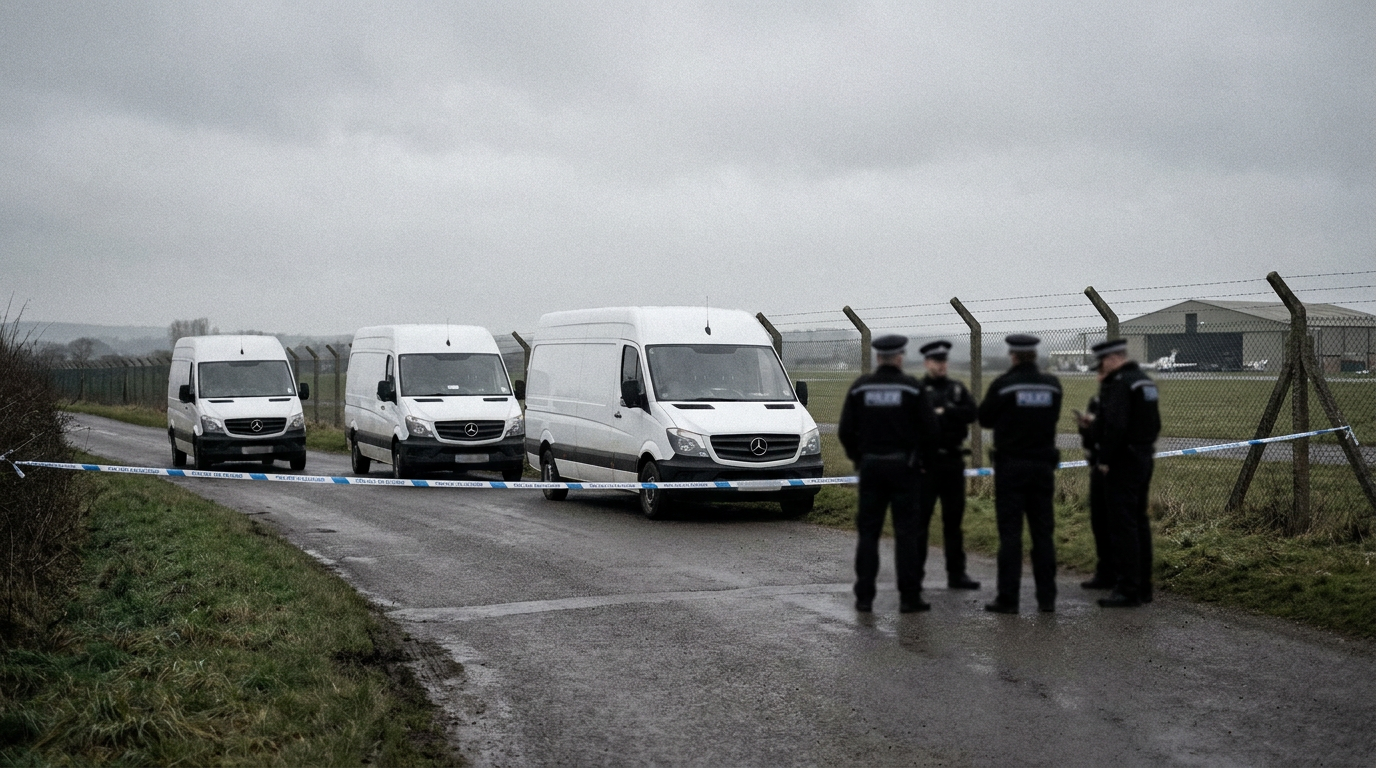
Five British men arrested near RAF Fairford have been released on police bail after testing established that material discovered in three vans was not viable as explosives. Counter-terrorism detectives are continuing their investigation into the incident outside the Gloucestershire air base.
The men, who are all from London and aged between 23 and 25, were detained in the early hours of Sunday. Their release comes with strict restrictions governing their movements and contact with other people, Assistant Commissioner Laurence Taylor said.
The emergency response led to the evacuation of 85 homes. Gloucestershire Police subsequently said residents could return, although officers were maintaining a cordon around the three vehicles. The vans had been parked about 350 metres from the base.
Barrels containing material were found inside the vehicles after five masked men were seen behaving suspiciously. During the arrests, the suspects were stripped of their clothing because officers feared they might be wearing suicide belts. That concern formed part of the initial response, rather than a finding that such devices were present.
The laboratory assessment changes the understanding of the contents of the vans. It does not resolve the separate questions detectives are examining about the circumstances in which the vehicles and their occupants came to be near the military site.
The background
A farmer encountered the vans and became suspicious of a telephone number and lettering displayed on them, which she thought looked false. The men fled after she came across them. Her account forms part of the circumstances surrounding the discovery outside the base.
Investigators are considering whether the incident could have involved a hoax, a diversion or a rehearsal for a possible attack backed by Tehran. These are lines of inquiry, not established explanations for the men's presence or findings of criminal responsibility.
Taylor said potential involvement by a hostile state remained within the scope of the investigation. That question concerns whether a foreign government had any role in the incident; it is distinct from the suspects' nationality. Police have identified all five as British citizens.
A precautionary response to suspected explosives and a subsequent assessment of the material serve different purposes. At the scene, officers must address a possible immediate danger. Testing allows a more specific judgement about what has been recovered, including whether it could function as an explosive.
Likewise, an evacuation is a protective measure rather than evidence that a suspected device would have worked. Decisions to move residents away can precede a technical assessment, particularly where potentially dangerous contents have been discovered and emergency personnel need space to examine them.
What people are saying
Speaking outside New Scotland Yard, Taylor linked the decision to grant bail to the interviews and inquiries already undertaken. He emphasised that detectives were pursuing several avenues and that release from custody should not be understood as the end of their work.
Iran's embassy in London rejected any Iranian responsibility. It described suggestions of a connection to Tehran as false and damaging, and argued that linking Iran to the incident risked encouraging hostility towards the country within the UK.
The embassy also placed its response in the context of United States and Israeli attacks on Iran, which it condemned. It said Iran reserved the option of legal action to protect the interests of the country and its people against damaging allegations.
Locally, the timing of the police decisions prompted frustration. Laura Stitt, a 40-year-old businesswoman, objected that the suspects had been granted bail while affected residents were still waiting to regain access to their homes. Residents were subsequently permitted to return.
Stitt also questioned the apparent speed with which the incident had been scaled down and the public resources committed to the response. Her concerns reflected the disruption experienced by people living nearby, as well as confusion over how the initial terrorism fears related to the later decisions.
Andy Burnham said he would chair an afternoon meeting of Cobra, the Government's emergency committee. Cobra meetings provide a means for ministers, officials and relevant agencies to coordinate their response to serious incidents requiring attention across government.
What happens next
The five men remain subject to the police investigation while on bail. In general, police bail allows a suspect to leave custody while further work takes place, with conditions used to manage identified risks. It is not a verdict on the allegation being investigated.
Conditions can restrict conduct outside a police station, but they do not themselves establish guilt. Taylor identified movement and contact restrictions in this case. Those controls concern the individuals, whereas a cordon controls access to a physical location; the two measures have different purposes.
An arrest is also separate from a charging decision. It allows police to detain and question someone where the relevant legal grounds exist. Any eventual prosecution would require its own evidential assessment, and a contested criminal charge would have to be proved in court.
For investigators examining suspected state involvement, the issue is a connection between the alleged conduct and a foreign state. That requires consideration beyond the presence of suspicious material alone. Iran's denial sets out its position, while the police inquiry concerns the evidence surrounding the incident.
The alternatives being examined also involve different possible purposes. A hoax could seek to create the appearance of danger; a diversion could draw attention elsewhere; a rehearsal could test preparations. Establishing intent is therefore a different task from determining the properties of the barrels' contents.
The presumption of innocence applies throughout that process. Neither the scale of an emergency deployment nor the location of an arrest is a substitute for proof of an offence. The five men must be treated as suspects under investigation, rather than as people found responsible for an attack.
Why this matters
For nearby households, an emergency evacuation affects access to ordinary essentials as well as accommodation: people separated from home may also be separated from medicines, clothing or work equipment. Returning residents still need to observe the remaining police boundary around the vehicles, even as access to the wider residential area resumes.
For the wider UK public, the practical distinction is between immediate safety decisions and the longer work of establishing criminal responsibility. A reduced restriction on a neighbourhood does not require every investigative question to have been settled. Equally, continuing a terrorism inquiry does not turn an initial fear about explosives into a proven threat.
Reporting that informed this story
This article was written independently by The Daily Times from publicly available facts and headlines. No text has been copied from the outlets above.