Police seek six men after Portsmouth disorder injured seven officers
Images have been issued as police investigate violence at Eastney Marina, damage to emergency vehicles and online threats against officers and rescue crews.

By Hannah Whitfield, Health Correspondent
Published 13 Sept 2026, 18:00
What happened
Detectives investigating violence on Portsmouth’s waterfront are asking the public to identify six men pictured in a new appeal. The investigation concerns an anti-immigration demonstration at Eastney Marina on 6 September, when seven police officers suffered injuries during disorder following the arrival of a boat from across the Channel.
About 200 people assembled at the marina on Sunday evening. Demonstrators obstructed roads to prevent coaches taking migrants away from the city, and the gathering continued overnight. Riot police dispersed those remaining at about 3am on Monday.
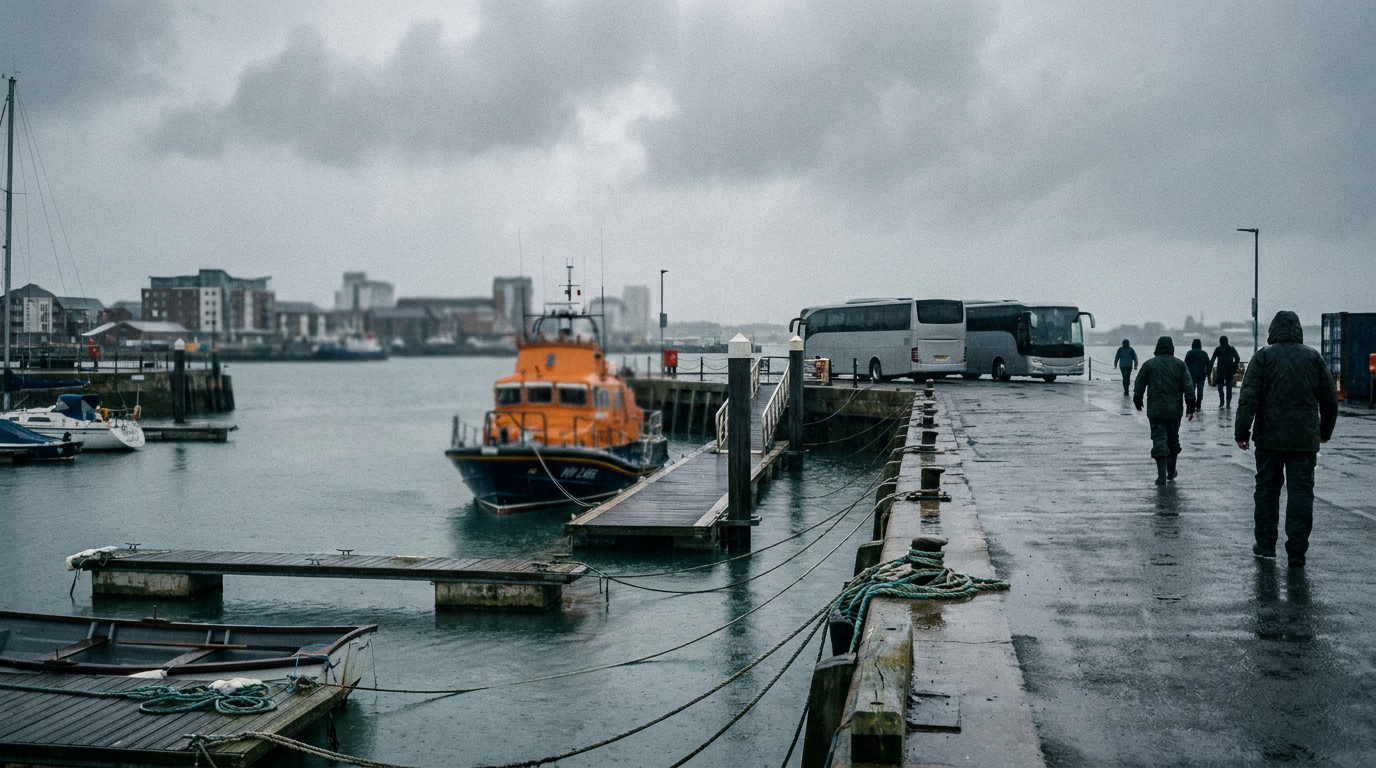
The confrontation extended to the shoreline, where dozens of protesters entered the water as a Coastguard vessel prepared to land people rescued from the dinghy. Others had run across the beach towards the sea during the operation to bring the passengers ashore.
Medical treatment was provided at the scene for the seven injured officers. Nobody attending the incident suffered serious injuries. Vehicles used by police, the Coastguard and Border Force were damaged during the evening, bringing several agencies involved in the response into the investigation.
Hampshire and Isle of Wight Constabulary issued the six images after examining hundreds of hours of video. Investigators want to speak to the men to help establish what happened. The appeal asks members of the public who recognise them to pass their information to police.
A separate part of the case has already reached court. Del Leon Somerville, 42, of Paulsgrove in Portsmouth, was charged on Friday with violent disorder and assaulting a police constable carrying out their duty. He appeared at Portsmouth Magistrates’ Court on Saturday morning and was remanded in custody.
Police also arrested a 16-year-old boy from Waterlooville on Saturday on suspicion of violent disorder connected with the marina incident. He was subsequently released on bail until 12 December while enquiries continue. An arrest or charge does not establish guilt; that is a matter for the courts.
The background
The decision to land the dinghy’s passengers in Portsmouth followed a crossing that began much further west along the French coast than the usual routes. The boat had departed from near Cherbourg, in the Bay of the Seine, rather than the area around Calais.
Cherbourg lies about 170 miles, or 274km, west of Calais. That starting point placed the boat on a different course from the crossings more commonly associated with the narrowest part of the Channel, and affected the options available to the agencies responding at sea.
Dover is normally the destination for migrants intercepted in the Channel, with initial processing taking place there. On this occasion, however, the passengers had already spent around 10 hours travelling before the decision about where to bring them ashore was made.
Reaching Dover would have meant another four to five hours on the journey. It would also have kept the responding lifeboats outside their usual patrol areas for longer. Those considerations formed part of the decision to use a landing point closer to the rescue operation.
Border Force and the Coastguard therefore chose Eastney Landing in Portsmouth. Lifeboats based at Bembridge and Yarmouth, both on the Isle of Wight, helped with the operation. The response brought together immigration officers, maritime rescue services and police at the same stretch of waterfront.
Migration analysts believe smugglers may be testing alternative departure locations to get around the substantial police presence in Calais and Dunkirk. That is an assessment of a possible change in their methods, rather than an established explanation for this particular boat’s route.
The Royal National Lifeboat Institution, known as the RNLI, provides a rescue service at sea, while Border Force carries out immigration and border-security work. Bringing someone to safety and considering their immigration position are distinct tasks, even when both arise from the same Channel crossing.
What people are saying
Assistant Chief Constable Tony Rowlinson has drawn a firm distinction between lawful protest and the conduct at Eastney. He described the Sunday evening events as public disorder and said the force would pursue people responsible for violence and damage, rather than treat those actions as peaceful demonstration.
The government has also condemned the intimidation and violence surrounding the incident while affirming the right to protest peacefully. Its response separated the freedom to express views about immigration from the behaviour directed at people and vehicles during the waterfront confrontation.
Rowlinson said the officers at Eastney had been working to protect everyone in the area. He criticised both the assaults they faced during the operation and the subsequent targeting of police personnel and people working for other agencies on social media.
RNLI crew members were among those singled out online after the landing. Posts circulated their names and photographs and accused them of treason. Police are investigating threats and abuse directed at officers and partner-agency staff, extending their enquiries beyond events on the beach and surrounding roads.
Explaining why enforcement can follow days after disorder, Rowlinson said officers cannot always make arrests while a public-order incident is unfolding. Video may need to be examined before investigators can distinguish individuals and connect particular actions with a possible offence.
Immigration remained the focus of demonstrations in Portsmouth the following Saturday afternoon. Around 500 anti-migrant protesters gathered in the city, where hundreds of counter-protesters from Stand up to Racism also assembled. The opposing demonstrations took place after Somerville’s court appearance that morning.
What happens next
Anyone able to identify a man in the police images can telephone 101 or submit information through the force’s online reporting service. The reference for the investigation is 44260435943, allowing information to be directed to the team handling the Eastney disorder.
Identification is one step in an investigation, not a finding that a pictured person committed an offence. Officers must assess what an individual can tell them alongside the other evidence. The public appeal describes the six men as people police want to speak to in connection with their enquiries.
The boy’s release on bail means his case remains under investigation, with 12 December set as his bail date. Bail is not the same as a charge, and enquiries can continue while a person is out of custody under that arrangement.
The force will work with policing colleagues on online threats arising from the incident. Rowlinson has also warned that unlawful behaviour at future demonstrations could lead to action and, where possible, prosecution. That warning covers subsequent events as well as the continuing investigation into Sunday’s disorder.
Why this matters
For people who live or work near a coastal landing point, a maritime rescue can quickly become a local policing and transport issue. In Eastney, the attempted obstruction involved coaches leaving the waterfront, placing the movement of rescued passengers at the centre of the confrontation on land.
The case also has a practical message for people attending demonstrations elsewhere in the UK: leaving an event does not end potential criminal liability. Investigators can use recordings and later identification appeals to examine individual conduct, while the right to peaceful protest remains separate from offences involving violence or damage.
Reporting that informed this story
- Daily Mail: Police release pictures of six men they want to speak to after violent anti-immigration protest in Portsmouth
- BBC News: Police searching for six men over anti-migrant protest in Portsmouth
- The Guardian UK: Police release images of six men sought after violent disorder in Portsmouth
This article was written independently by The Daily Times from publicly available facts and headlines. No text has been copied from the outlets above.