Putney pusher suspect Nicholas Brandram found dead in Chiswick
The 44-year-old HSBC banker was under investigation over the 2017 Putney Bridge incident. Police are not treating his death as suspicious.

By Eleanor Hartley, Editor
Published 16 Sept 2026, 18:00
What happened
Nicholas Brandram, the banker being investigated over a woman being pushed towards a bus on Putney Bridge, has died at his home in Chiswick, west London. The 44-year-old was arrested in June in connection with the incident, which happened nine years ago.
Police and ambulance crews attended the property on Tuesday evening after Brandram was discovered unresponsive. He was pronounced dead there. The Metropolitan Police said the death was unexpected and that officers did not suspect suspicious circumstances. His next of kin have been told.
Brandram remained under investigation over the 2017 bridge incident. Last week, the Met confirmed that he had been released under investigation following his arrest on suspicion of attempted grievous bodily harm. That was his procedural status when he died.
During his time in police custody in June, officers also arrested him on suspicion of possessing drugs. That arrest concerned a separate suspected offence from the allegation relating to the woman on the bridge.
Brandram was a director at HSBC and had recently worked in private banking. Before his banking career, he served in Afghanistan as a captain in the Scots Guards.
His family connections included European royalty. Princess Katherine of Greece was his grandmother, while Prince Philip, the late Duke of Edinburgh, was godfather to Brandram’s father.
The background
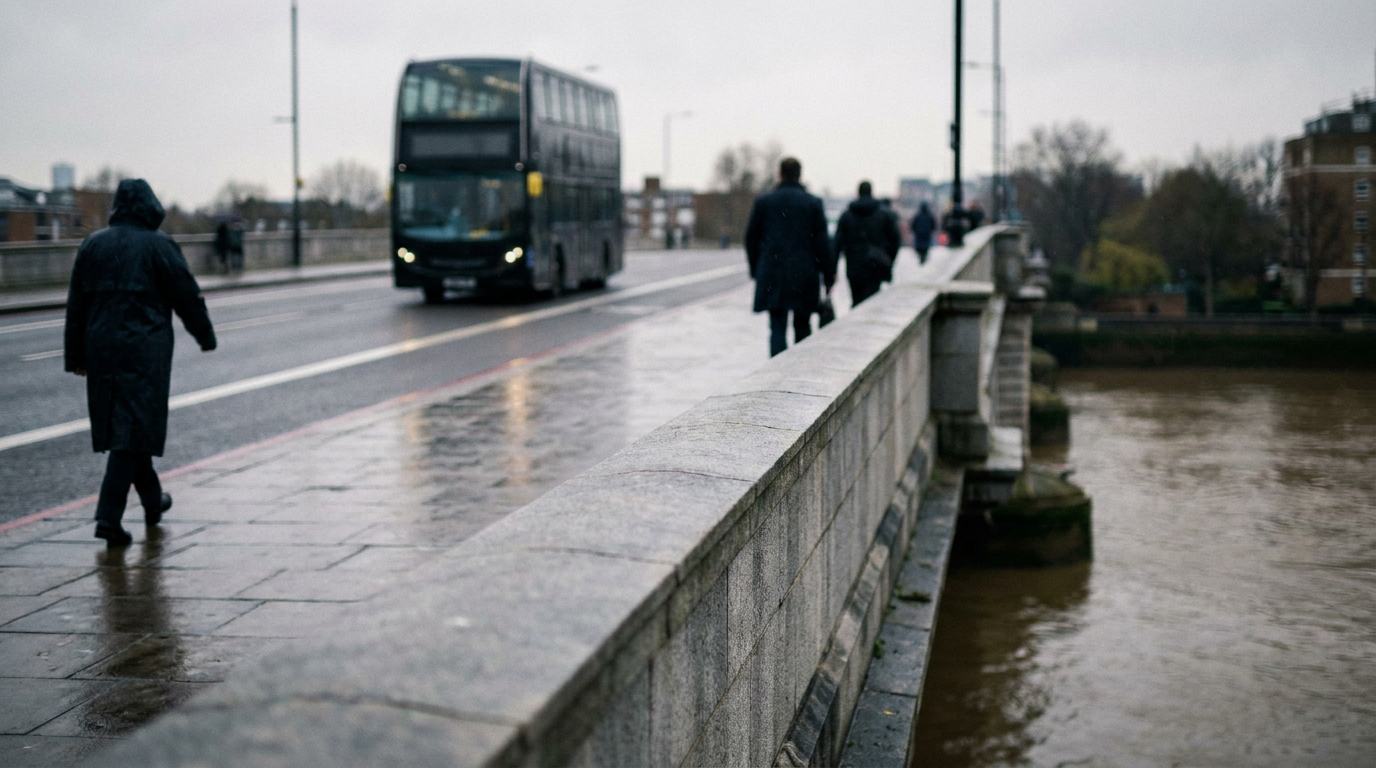
The case became widely known as the “Putney pusher” investigation after CCTV footage circulated showing a woman being pushed into the path of a route 430 bus. The incident took place on Putney Bridge in west London in 2017 and involved a man who was running.
The woman came close to being struck, but the driver steered away from her. The footage brought attention both to the push and to the driver’s rapid response as the woman entered the vehicle’s path.
Detectives considered more than 50 people of interest during their enquiries. Three men were arrested during the original investigation and subsequently released without charge. The Met closed that investigation in 2018.
An investigation being closed does not amount to a court ruling on an incident. Police can return to a previously closed case, and an earlier decision to stop active enquiries does not legally prevent a later arrest or further investigation.
Brandram’s arrest in June this year brought a further investigative step in a case dating back almost a decade. The suspected offence was attempted grievous bodily harm, rather than an allegation that the woman had actually sustained grievous bodily harm.
That distinction concerns the conduct and intention police were investigating. In England and Wales, an allegation of an attempted offence can be considered even where the intended result did not occur. An arrest on that suspicion does not establish that the arrested person committed the act or had the necessary intent.
What people are saying
The Metropolitan Police’s account of the death focused on the emergency response at the Chiswick address. The force confirmed that officers attended with paramedics, that a 44-year-old man died at the scene and that his family had been informed.
The principal public accounts of the danger on the bridge date from the original investigation. Sergeant Mat Knowles, an investigating officer, credited the bus driver’s swift response with preventing the vehicle from hitting the woman.
Oliver Salbris, who was driving the bus, later described his steering manoeuvre as an instinctive reaction. He said that continuing on the same course would have meant striking the woman’s head, with grave consequences for her and for him. His account concerned the immediate danger, rather than the identification of the runner.
Understanding the investigation
Release under investigation is a police status used while enquiries continue after someone leaves custody. It is not a criminal charge, a conviction or a finding that an allegation is true. A suspect in that position retains the presumption of innocence.
It also differs from release on police bail. A person released under investigation is not subject to bail conditions through that status and does not have a bail appointment requiring them to return to a police station on a specified date.
Police may continue gathering and assessing evidence during that period. Depending on the case, that work can include examining recordings, obtaining witness accounts and considering whether evidence connects a particular person to the alleged offence. Those are general investigative steps, rather than a description of individual enquiries undertaken into Brandram.
A charging decision is a separate stage from an arrest. For a serious allegation, prosecutors ordinarily consider whether the evidence offers a realistic prospect of conviction and whether prosecution would be in the public interest. The threshold for arrest on suspicion is not the same as the test for bringing a case to court.
CCTV can document an event while leaving the identity and intention of a person shown in it as separate questions for investigators. Widely circulated footage does not, by itself, settle every element that a criminal prosecution would need to prove.
What happens next
Brandram’s death means that a criminal prosecution against him cannot proceed. Criminal courts determine allegations against living defendants; they do not conduct a posthumous trial to decide whether a deceased suspect was guilty.
That does not turn his status as a suspect into a finding either way. An arrest and subsequent release under investigation remain distinct from a judicial determination, regardless of how much public attention an allegation has received.
A suspect’s death also does not automatically resolve every question about the underlying event. Police can retain evidence concerning an incident and consider whether further enquiries serve an investigative purpose. Decisions about the wider case are separate from the impossibility of prosecuting the person who has died.
The handling of an unexpected death follows a different process from investigating an alleged assault. In England and Wales, certain deaths must be referred to a coroner, including where the cause is unknown or there is reason to suspect a violent or unnatural death.
Where a coroner investigates, the task is to establish who died and how, when and where the death occurred. That process is not a substitute for a criminal trial and does not determine guilt over a separate allegation involving the deceased.
Why this matters
For people using London’s roads, the original incident illustrates the immediate risk when a pedestrian falls into a moving vehicle’s path. The driver’s intervention prevented a collision on a bridge used by both pedestrians and buses; the police and the driver each described how narrowly that collision was avoided.
For readers following criminal cases in the UK, the distinction between suspicion and proof is equally practical. The investigation into Brandram concerned attempted serious harm, but his arrest was not a verdict. His death ends the possibility of a prosecution against him without producing a court finding about his involvement.
Reporting that informed this story
- The Guardian UK: Suspect in ‘Putney pusher’ case found dead at his west London home
- BBC News: 'Putney pusher' suspect found dead at home
This article was written independently by The Daily Times from publicly available facts and headlines. No text has been copied from the outlets above.