Trump backs Irish unity during Dublin visit, drawing unionist anger
The US president urged movement towards a united Ireland as unionist parties defended Northern Ireland’s right to decide its constitutional future.

By Marcus Odell, Political Correspondent
Published 12 Sept 2026, 13:00
What happened
Donald Trump has backed Irish unification during a visit to Dublin, arguing that it should happen sooner rather than later and prompting objections from Northern Ireland’s unionist parties. The US president made his intervention on Saturday 12 September while meeting Taoiseach Micheál Martin at Farmleigh House.
Sitting alongside the Irish prime minister, Trump presented unity as an outcome he expected eventually and suggested Martin could help advance it. He acknowledged that the United Kingdom would have a role in the issue, while describing unification as something he personally supported.
His comments brought Northern Ireland’s constitutional position into the opening day of a two-day trip combining political meetings, business engagements and golf. The programme includes Dublin and the president’s golf resort at Doonbeg in County Clare, which is hosting the Irish Open.
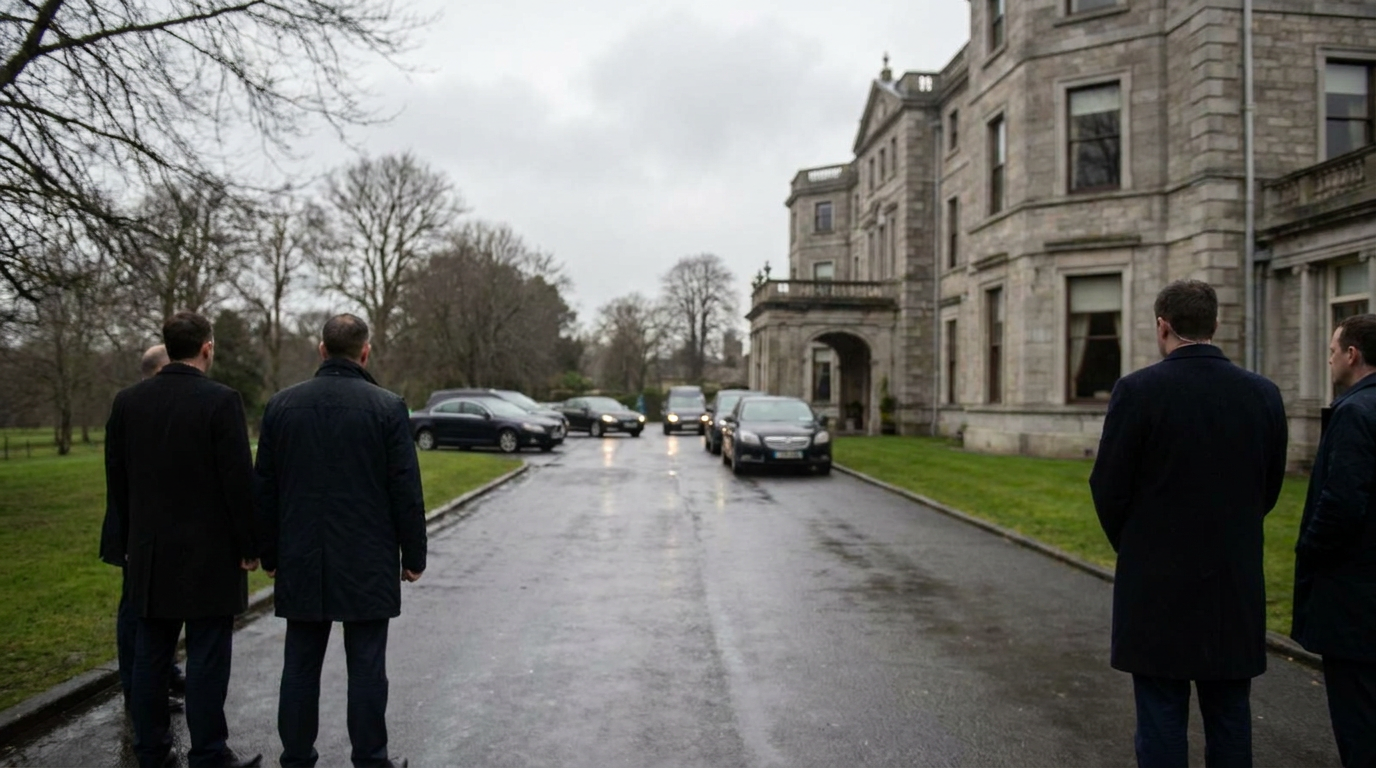
Trump arrived at Dublin Airport on Air Force One on Saturday morning and was welcomed by Irish finance minister Simon Harris. Police officers and security personnel were positioned around the arrival before the president left in a motorcade.
Before meeting Martin, Trump visited Irish president Catherine Connolly at Áras an Uachtaráin, her official residence in Dublin’s Phoenix Park. Martin’s wife, Mary O’Shea, also attended the welcome at Farmleigh House.
Opponents of the visit gathered in central Dublin for a protest march beginning at the Garden of Remembrance. Demonstrators carried flags and banners and chanted against the president’s presence in Ireland.
The background
The island of Ireland contains two jurisdictions: the independent Irish state and Northern Ireland, which forms part of the UK. Unification would change that constitutional arrangement, rather than simply deepen co-operation between the governments in Dublin and London.
The central safeguard governing Northern Ireland’s status is the principle of consent, embedded in the Belfast Agreement, also known as the Good Friday Agreement. It means that a change from membership of the UK to a united Ireland depends on the wishes of a majority in Northern Ireland.
That framework distinguishes support for unity expressed by a political leader from the democratic authority needed to bring it about. Neither the Irish government nor an American president can settle Northern Ireland’s constitutional future by agreement between themselves.
Unionists support Northern Ireland remaining in the UK, while Irish nationalists favour a united Ireland. Those positions concern national identity and sovereignty as well as the institutions through which people are governed. The consent principle provides the mechanism for resolving the constitutional question democratically.
The United States also has substantial economic links with Ireland. During his meeting with Martin, Trump highlighted Ireland’s position as the sixth-largest source of foreign direct investment in the US and praised the business leaders present.
The visit takes place during the war with Iran, which also featured in Trump’s exchanges with journalists. Asked about people in Ireland paying 40% more for heating oil than before the conflict, he turned to British energy policy and advocated opening North Sea oil and gas fields.
What people are saying
The Democratic Unionist Party and the Ulster Unionist Party rejected Trump’s intervention. Their responses stressed that voters in Northern Ireland, rather than political figures speaking from other capitals, have the authority to determine whether it remains within the UK.
Unionist objections also focused on the benefits they associate with the Union. The responses expressed confidence that Northern Ireland would continue to choose the UK and argued that membership offered greater security and prosperity than joining the Irish state.
Jim Allister, leader of Traditional Unionist Voice, accused Trump of interfering in an issue outside his authority. He also objected to Northern Ireland being drawn into disagreements between the president and the UK, framing the intervention as an unwelcome intrusion into its affairs.
The unionist reaction nevertheless recognised the importance of the American relationship. It referred to shared security interests and US business investment, separating those connections from the question of who has the right to decide Northern Ireland’s future.
A spokesperson for Martin said Trump’s remarks would not alter Irish government policy. In London, a spokesperson for the prime minister said his position on Irish unification remained unchanged. Those responses treated the president’s comments as an expression of his views rather than a reason to change their governments’ approach.
Ahead of the visit, Martin said he wanted discussions to reinforce the economic, cultural and personal connections between Ireland and the US. He placed the engagements in the context of issues affecting both countries and a summer of major sporting activity.
Asked about the demonstrations, Trump said he had not seen protesters during his movements that morning and played down their scale. Later, in a speech at Deerfield, he praised Ireland and its people, saying his affection for the country went beyond his investments there.
What happens next
Trump’s itinerary continues beyond the political meetings with engagements involving business leaders and a visit to Doonbeg. The Irish Open places his County Clare property at the centre of the sporting element of the trip, alongside time allocated for golf.
Protecting the visit involves a major deployment by Irish police and other security personnel. The operation covers a presidential programme spanning the capital and the west of Ireland, while demonstrations are taking place in Dublin.
Any move towards Irish unity would follow the constitutional process rather than the presidential itinerary. Under the legal framework accompanying the Belfast Agreement, the UK’s Northern Ireland secretary has responsibility for calling a referendum on whether Northern Ireland should remain in the UK or become part of a united Ireland.
The secretary of state must call such a poll if it appears likely that a majority would support leaving the UK for a united Ireland. A vote for constitutional change would require further action by the British and Irish governments; a presidential endorsement does not replace those responsibilities.
Beyond Ireland, Trump predicted that the Iran war would finish soon and also linked its conclusion to the period after the US midterm elections. His comments addressed a conflict whose energy consequences had already become part of the questions put to him during the visit.
Why this matters
For people in Northern Ireland, the practical significance of the unity debate extends to the state responsible for taxation, public services and democratic representation. The consent requirement gives voters there the decisive role over whether their constitutional position changes, regardless of the prominence of overseas supporters or opponents.
For readers elsewhere in the UK, Trump’s North Sea intervention brings a separate domestic policy dispute into the visit. He argued that greater production would reduce energy prices, connecting his criticism of Labour’s approach with household heating costs across the Irish Sea. That was a policy argument from the president, not a change to what households pay.
Reporting that informed this story
- The Guardian UK: Trump says he would ‘love’ to see unified Ireland and ‘it may as well happen now’ as he visits Dublin – live
- Daily Mail: Donald Trump says he would 'love to see' a united Ireland - saying 'it's going to happen eventually' on visit to Dublin
This article was written independently by The Daily Times from publicly available facts and headlines. No text has been copied from the outlets above.