Two men re-arrested in Iran inquiry over RAF Fairford incident
Counter-terrorism police are investigating suspected assistance to Iranian intelligence after an incident near the Gloucestershire airbase.

By Eleanor Hartley, Editor
Published 20 Oct 2026, 18:01
What happened
Two men from Westminster in central London have been re-arrested on suspicion of helping a foreign intelligence service as counter-terrorism officers investigate an incident near RAF Fairford. Police say the suspected intelligence connection concerns Iran.
The arrests, announced on Tuesday 20 October, concern a 24-year-old British national and a 25-year-old man with British and Iranian nationality. Officers used section 3 of the National Security Act 2023, bringing a state-security offence into an investigation that had already involved arrests on terrorism grounds.
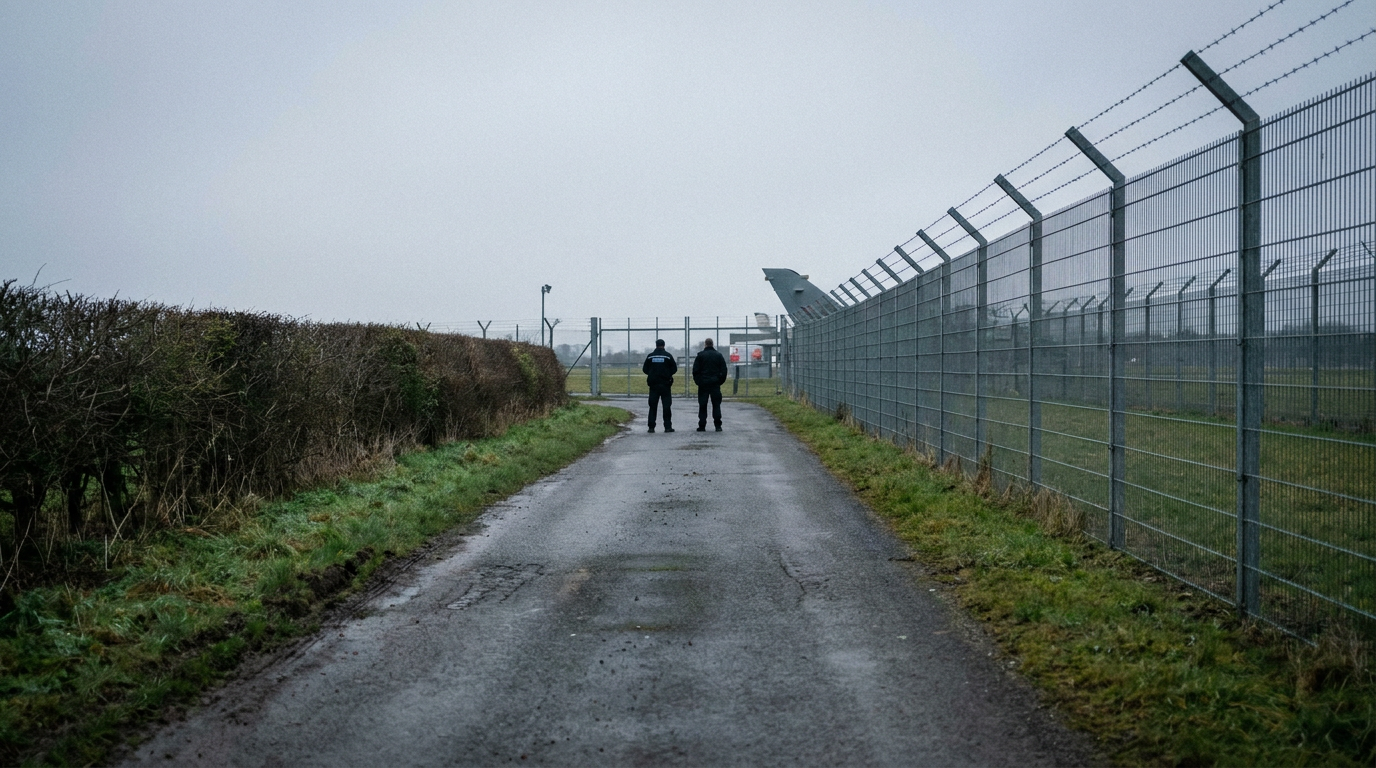
The inquiry began after Gloucestershire Police received a call at 00:45 BST on 27 September about three vehicles heading towards the airbase. The response developed into a major incident, with people evacuated from dozens of homes nearby.
Bomb disposal specialists attended to assess vehicles in the area. Officers found petrol in three vans near the base, but police subsequently said their searches had not uncovered any improvised explosive devices. Five men were arrested during the initial response.
Seven men have been arrested over the course of the investigation. The two now re-arrested had previously been released on police bail; the other five remain on bail. The latest arrests therefore concern existing suspects rather than two additional people.
The incident happened near the Royal Air Force station in Gloucestershire, which is used by the United States military. The investigation concerns activity outside the airbase, alongside the emergency response that affected the surrounding community.
The background
The initial arrests were made on suspicion of offences under explosives legislation. Those detained were then further arrested on suspicion of preparing a terrorist act. These were different legal grounds from the suspected assistance to a foreign intelligence service now being investigated.
The younger of the two men re-arrested was first detained near Fairford on 27 September. The 25-year-old was initially arrested in Westminster on 1 October on suspicion of preparing terrorist acts, extending the inquiry from Gloucestershire to central London.
A further arrest followed in Westminster on 6 October, when officers detained a 22-year-old British national. He is among the five men who remain on police bail while the investigation continues.
Police bail allows an arrested person to be released while an investigation proceeds. It does not amount to a finding of guilt or a decision that the inquiry has ended. Investigators can continue collecting and assessing evidence after a suspect leaves custody.
An investigation can also examine the same underlying events under more than one criminal law. Terrorism legislation and national security legislation address different legal questions: the former includes preparation for terrorist acts, while the provision used in the latest arrests concerns assistance to a foreign intelligence service.
What the law covers
Section 3 of the National Security Act 2023 addresses conduct capable of providing substantial help to an intelligence service acting for another country. Its focus is the assistance that conduct could provide, rather than simply whether a person has contact with someone overseas.
The offence includes a knowledge requirement. A prosecution must establish that the person knew, or should reasonably have known, that their conduct was likely to provide material assistance to a foreign intelligence service. Suspicion sufficient for an arrest is not the same as proof sufficient for conviction.
The legislation also sets out the necessary connection with the UK. It covers relevant conduct taking place here, as well as conduct overseas where the assistance relates to a foreign intelligence service's activities concerning the UK. Those territorial rules define the reach of the offence.
Nationality alone does not establish any of those elements. The fact that one suspect is British and the other holds both British and Iranian nationality describes their citizenship; the criminal allegation concerns what they are suspected of doing and their knowledge of its significance.
The absence of an improvised explosive device does not, by itself, answer the separate legal question raised by section 3. An allegation of assisting an intelligence service must be assessed against that offence's requirements, rather than treated as dependent on the discovery of a particular weapon or device.
What people are saying
Assistant Commissioner Laurence Taylor, who leads national counter-terrorism policing, said investigators regarded Iranian state involvement as very probable. He presented that as the police assessment in an active inquiry, with evidence still being gathered.
Taylor said officers were examining the extent of any Iranian involvement and what those involved intended to achieve. That distinction places both the possible relationship with a foreign state and the purpose of the activity under investigation.
Prime Minister Andy Burnham has previously said the government's assessment was that Iran had a role in the incident. His comments addressed the wider question of state involvement, rather than determining the criminal responsibility of any individual suspect.
Taylor described the inquiry as complex, with specialist officers pursuing numerous investigative avenues. He also said the sensitivity of national security work could make progress time-consuming, while emphasising the importance of protecting the investigation's integrity.
The counter-terrorism chief acknowledged public questions about the case and said he wanted to provide further information when officers were able to do so. He thanked those who had allowed investigators the time and space to carry out their work.
What happens next
Evidence-gathering remains the immediate task. Investigators must assess the suspected conduct of individuals as well as the possible involvement of a state. A broad assessment about Iran's role does not remove the need to establish evidence relating to each person under investigation.
Any decision to prosecute would require a separate assessment under the criminal justice process. In England and Wales, prosecutors generally consider whether the evidence offers a realistic prospect of conviction and whether bringing a prosecution is in the public interest.
A court, rather than the police or government, determines guilt if an allegation proceeds to trial. The prosecution must prove its case to the criminal standard, and defendants are presumed innocent. Re-arrest does not change those safeguards or establish that an offence occurred.
For those released on bail, the investigation and their release from custody are separate matters. Bail conditions, where imposed, regulate a suspect's conduct during the process; they are not a criminal sentence. The continuing inquiry therefore involves people with different custody positions but the same presumption of innocence.
Why this matters
For residents near military sites, the Fairford incident demonstrates how a security response can disrupt nearby households as well as the installation itself. Evacuations are protective measures taken during an emergency; they do not, on their own, establish what investigators will ultimately find.
For the wider UK public, the case concerns the potential use of national security law alongside a counter-terrorism investigation. The practical distinction is between assessing a possible foreign-state threat and proving an individual's criminal conduct: the first informs the inquiry, while the second requires evidence tested through the justice system.
Reporting that informed this story
- The Guardian UK: Two men re-arrested on suspicion of aiding Iran over RAF Fairford incident
- BBC News: Two re-arrested on suspicion of assisting Iran intelligence after RAF Fairford incident
- Daily Mail: Two men arrested over suspected RAF Fairford 'terror plot' are rearrested on suspicion of helping Iran's intelligence service
This article was written independently by The Daily Times from publicly available facts and headlines. No text has been copied from the outlets above.