Macron calls crisis talks as looting follows protests across France
More than 1,200 people have been arrested after unrest accompanied nationwide demonstrations, with about 1,500 businesses damaged.
By James Reeve, Foreign Affairs Writer
Published 18 Oct 2026, 18:00
What happened
President Emmanuel Macron has convened emergency talks after demonstrations across France were accompanied by looting, fires and clashes with police. Renewed disorder in Paris on Sunday followed nationwide protests involving roughly 550,000 people, although most gatherings remained peaceful.
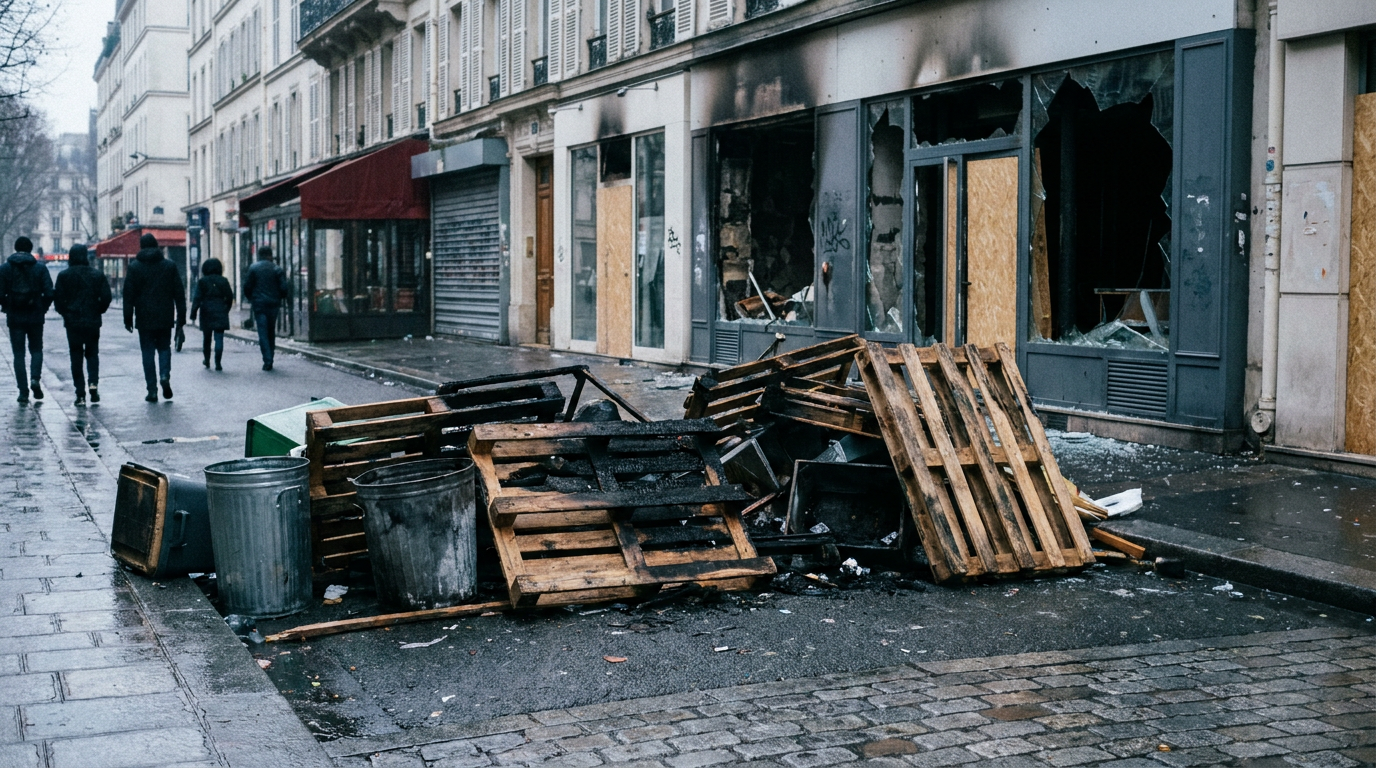
More than 1,200 demonstrators were arrested as violence broke out alongside protests about living costs, education standards and the government. In Paris alone, police made 855 arrests on Saturday, when masked demonstrators fought officers and buildings and shops were broken into and set alight.
The damage extended beyond the capital. Businesses in Marseille, Bordeaux, Nice and Strasbourg were also targeted during the weekend. The Retail and Trade Federation estimated that around 1,500 businesses had suffered damage, putting the financial losses at hundreds of millions of dollars.
On Sunday, several hundred people assembled at Place de la République in Paris after calls circulated on social media. The square, a regular meeting point for demonstrations, had been among the locations affected by clashes and looting the previous day.
The Paris police prefecture said Sunday's gathering had not been authorised. Officers conducted checks and deployed around the square before moving to break up the crowd and make arrests when tensions began to rise. Police were again confronting protesters as further looting took place.
At one supermarket, a woman tried to stop a group of young men entering the damaged premises. They pushed past her and subsequently emerged carrying stolen goods. The confrontation illustrated how people at individual businesses were caught up in the disorder beyond the main demonstrations.
One person died during the main march in Paris. Officials attributed the death to a health-related cause, distinguishing it from the violence that accompanied parts of the protests.
Macron was expected to speak to the nation at 7pm British Summer Time, or 8pm in France, after meeting senior ministers at the Elysée Presidential Palace. The talks brought together those responsible for the government's overall response, policing and the justice system.
The background
The demonstrations drew together several grievances rather than a single demand. Household living costs, standards in education and opposition to Macron's administration were all among the reasons people took to the streets. Their breadth gave the mobilisation both an economic and a political character.
The cost of living concerns the relationship between household income and everyday spending, including food, housing, energy and transport. Pressure on those budgets can persist even when the pace of price increases eases: slower inflation does not itself return prices to their previous levels.
Education adds a different dimension to that financial discontent, reaching beyond immediate household bills to the quality of public services. Together, the issues place attention on both what families can afford privately and what they receive through government provision.
The peaceful character of most gatherings is an important distinction when assessing the weekend. The national attendance figure covers the wider demonstrations; it is not a count of people involved in rioting. The arrests and damage concern disorder that developed alongside that broader mobilisation.
Likewise, an arrest is not a conviction. Police detention forms part of an investigative process, while criminal responsibility must be considered individually. The scale of arrests indicates the size of the policing operation, but does not establish the guilt of everyone detained.
France's executive divides responsibilities between the president and a government headed by the prime minister. A crisis meeting involving the interior and justice portfolios allows the immediate public-order response and its legal consequences to be considered together, rather than as separate local incidents.
What people are saying
Marine Le Pen, the far-right National Rally presidential candidate, portrayed the unrest as evidence that Macron's government had lost its ability to provide effective leadership. She argued that weakened public confidence and authority carried wider risks for France's democracy.
Le Pen, who leads opinion polls ahead of the election, blamed ultra-left groups for the violence. That accusation formed part of a sharply divided political response to the unrest, with opponents offering competing explanations for how the situation had escalated.
Jean-Luc Mélenchon, the leader of the far-left France Unbowed party, directed his criticism at the authorities, accusing them of aggravating tensions. His position placed responsibility in a different quarter from Le Pen's, underlining the dispute over the conduct of both protesters and the state.
For residents near damaged streets, the reaction was more immediate. Mehmet Ozeden, a 78-year-old Paris resident, described destruction on a scale he associated with warfare as he stood near the remains of burnt barricades. His response reflected the impact on people living close to the clashes.
Another resident, Anita Gras, recounted watching young men take goods from a shop selling sports shoes. Her account concerned the theft from a particular retailer, rather than the political demands being voiced at the demonstrations.
Cecile Rogue, 57, expressed fear and anger while looking at charred bicycles. She described groups of young people breaking and stealing property, and felt they had been able to do so without being stopped.
The Retail and Trade Federation's assessment focused on the commercial toll. Its estimate covered losses across affected businesses, rather than simply the number of premises attacked. Damage to a shop can involve both physical repairs and the loss of goods that would otherwise have been sold.
What happens next
Prime Minister Sébastien Lecornu, Interior Minister Laurent Nuñez and Justice Minister Gérald Darmanin attended the emergency meeting with Macron. Government Secretary General Laurence Marion was also present, bringing the senior administration into the discussions at the presidential palace.
Macron's expected national address was the next scheduled public intervention. It would give the president a direct opportunity to respond to the unrest after discussions with ministers whose responsibilities span security, justice and the coordination of government business.
For those arrested, any subsequent criminal proceedings require decisions about individual cases. Arrest totals alone do not determine whether someone will face a charge or appear in court; those steps belong to the legal process that follows police action.
For damaged businesses, the practical recovery involves assessing premises and stock before repairs and replacement can be organised. The federation's estimate is expressed as an approximate financial total, rather than a completed bill for every affected shop. The work facing individual traders will depend on the damage to their property.
Why this matters
For people in the UK travelling to France, the relevant geography extends well beyond Paris. Disorder affected several major cities, making local conditions important when planning journeys within them. Travellers should check current official travel advice and information from their transport operator before setting out.
British travellers also need to distinguish a demonstration from violence nearby: most of the weekend's gatherings were peaceful. Keeping away from active clashes and following instructions from local authorities are practical precautions, particularly around gathering points such as Place de la République.
Reporting that informed this story
This article was written independently by The Daily Times from publicly available facts and headlines. No text has been copied from the outlets above.