Spain train crash: death toll reaches 64 after Toledo collision
Two high-speed trains collided in Toledo province, leaving more than 80 people injured and prompting scrutiny of the line’s automatic safety system.

By James Reeve, Foreign Affairs Writer
Published 28 Oct 2026, 13:00
What happened
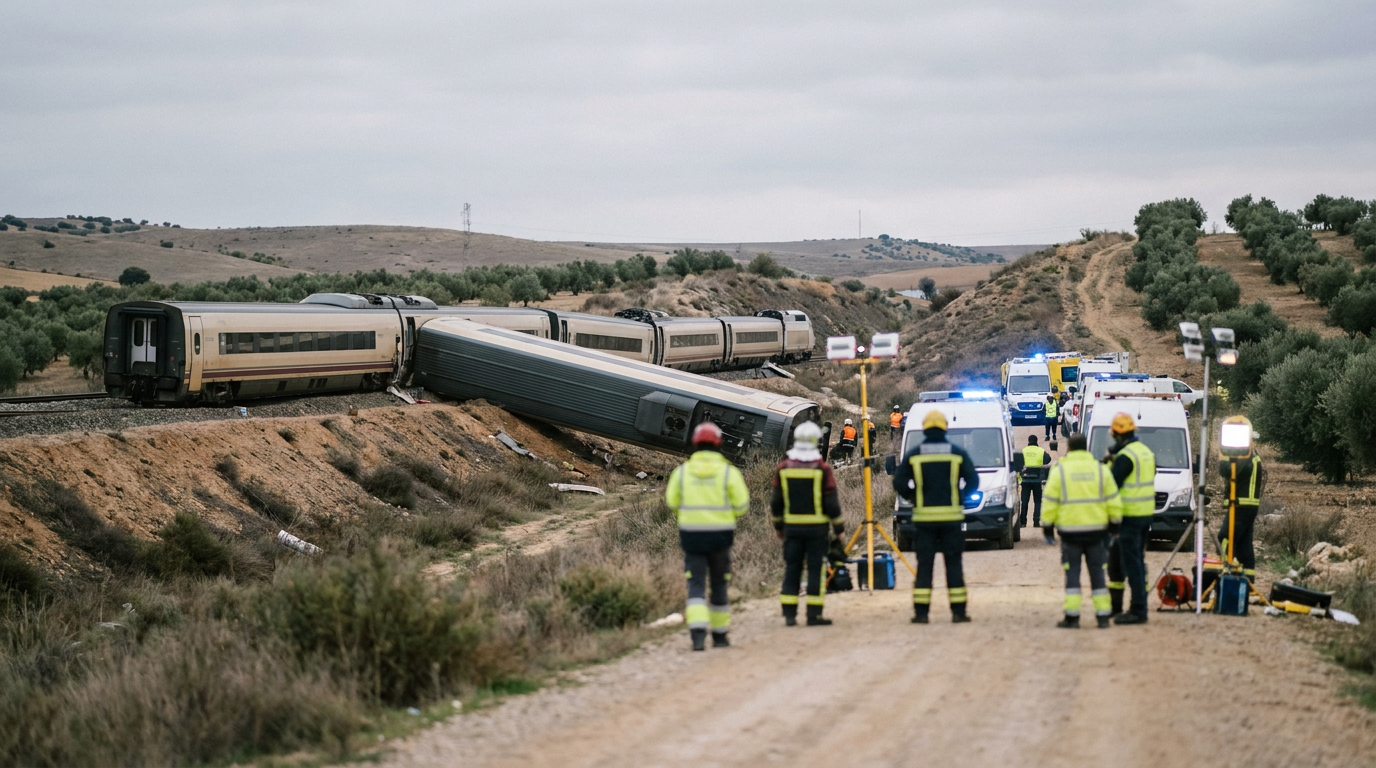
The death toll from a collision between two high-speed passenger trains in Spain has reached 64, according to regional government officials in Castilla-La Mancha. More than 80 people were injured in the crash in Toledo province, with emergency teams working among derailed and badly damaged carriages.
The collision happened shortly after 9am local time near Urda, roughly 150km south of Madrid. An Iryo train heading from Madrid towards Seville had stopped when a Renfe service travelling along the same route struck it from behind.
Carriages from both trains left the tracks. Two went down an embankment, where many of the victims were believed to have been travelling. One carriage caught fire, and smoke remained visible as the first emergency crews arrived.
The services involved were Iryo 7076 and Renfe’s AVE 2080. Passenger figures put 146 people and a baby on the Iryo train and 397 on the AVE service, giving an estimated combined total of 544.
Castilla-La Mancha president Emiliano Garcia said 50 of the injured were in a serious condition. The scale of the casualties emerged progressively during the emergency response, with an earlier death toll of 31 subsequently rising to 64.
Dozens of emergency vehicles gathered around the railway, while a helicopter flew above the site. Passengers evacuated damaged coaches as rescue workers reached sections of the wreckage where people had been trapped.
Adif, which manages the railway infrastructure, suspended traffic on the Madrid–Andalusia high-speed line. The closure affects the corridor linking the capital with southern Spain, extending the disruption beyond passengers aboard the two trains involved.
The background
The collision involved two operators using the same high-speed route. Renfe is Spain’s state rail operator, while Iryo is a private company. The trains can reach 300km/h, approximately 186mph; that is their maximum capability, rather than an indication of their speed at impact.
Spain had already suffered a fatal collision on the same line at Adamuz in January, when 46 people died. That crash involved trains colliding head-on, and faulty rails were identified. The Toledo collision presents a different safety question because one train struck the rear of another.
With 64 deaths, the latest crash is Spain’s third deadliest rail disaster since the 1970s. In 1972, a head-on collision between passenger trains at El Cuervo, in Seville province, killed 86 people and injured 112.
Another disaster, at Angrois near Santiago de Compostela in Galicia in 2013, killed 80 people and injured more than 140. The protection system involved in that crash allowed a driver to disregard speed warnings, unlike the automatic intervention intended on the Madrid–Seville route.
How the safety system works
The line uses a signalling system known as LZB, whose name translates as linear train control. It maintains continuous electronic communication between equipment on the railway and the train, allowing the system to regulate speed throughout a journey.
A central protection is its ability to stop a train automatically when the track ahead is occupied. That intervention should take place even if the driver does not apply the brakes, providing a safeguard against a rear-end collision.
The distinction matters because a warning and an automatic brake command perform different jobs. A warning requires the driver to respond; automatic protection is designed to intervene when that response does not happen. Investigators will examine how those protections operated before the impact.
LZB was used in Germany before its installation on the Spanish high-speed railway. Its continuous supervision means the safety arrangements on this route differ from those on lines where a driver must react to a signal without equivalent automatic stopping protection.
A fatal rear-end collision on Britain’s Midland main line earlier this year occurred on a stretch without technology that would automatically stop the following train. Its driver passed a red danger signal without braking. It was Britain’s first fatal collision of that type between passenger trains in more than 40 years.
Spain is also moving towards the European Rail Traffic Management System, or ERTMS, as part of the wider European transition towards common signalling technology. The existing LZB equipment is therefore part of a network undergoing a longer-term change in how train movements are controlled.
What people are saying
Train drivers’ unions have questioned how the collision could occur given the signalling protections on the route. Their concern centres on the apparent conflict between an occupied line and a system intended to prevent another train from reaching it.
Castilla-La Mancha spokeswoman Esther Padilla warned that the casualty figures were likely to increase as the response continued. Her assessment reflected the severity of the incident while rescuers were still working through the damaged trains.
Sebastián Herrero, a 46-year-old passenger on the Iryo service, described being hurled against seats and briefly lifted into the air by the impact. He also described extensive destruction at the back of the train and rescuers removing victims from those carriages.
Another passenger, Miguel, who was travelling with colleagues in a rear carriage, recalled a prolonged crashing sound lasting about 10 seconds. Through a window on the right, he could see another badly damaged train alongside them.
Andalusia’s emergency minister, Antonio Sanz, said former Spanish labour minister Fátima Báñez was believed to have been on one of the services. He said she had not been reached since the collision.
The Spanish football federation postponed all Copa del Rey first-round matches scheduled for the day as a mark of respect. It expressed support for those affected and for the authorities assisting victims.
The European Commission offered assistance to Spain, including support through the European Union Agency for Railways. A spokesperson said both institutions were following developments closely, while cautioning against reaching conclusions about the cause during the emergency response.
What happens next
Spain’s transport minister, Óscar Puente, was due to address the crash at 2pm local time, or 1pm in the UK. The briefing follows the suspension of the line and the sharp increase in the number of confirmed deaths.
The technical inquiry will need to establish why the Iryo service stopped and how the following train came to strike it. The operation of the signalling system, particularly its automatic stopping function, will be central to understanding the sequence.
That examination is distinct from the rail defects identified after Adamuz. A rear-end collision on a continuously supervised railway requires investigators to examine the protection against an occupied section of track, rather than assume the two disasters had the same cause.
The football federation will issue a replacement schedule for the postponed cup fixtures. Its decision covers the first-round games due that day, rather than the competition as a whole.
Why this matters
For UK visitors travelling within Spain, the suspension affects a high-speed corridor serving journeys between Madrid and Andalusia. Rail plans using that route are therefore caught up in the disruption, not just bookings with the two operators whose trains collided.
For British rail passengers, the safety comparison concerns the protection fitted to a particular line, not simply the speed of its trains. The Toledo and Midland main line collisions involve different signalling arrangements, making the performance of automatic braking a practical focus of the Spanish investigation.
Reporting that informed this story
- Daily Mail: At least 31 passengers dead and 80 injured as two trains collide in Spanish rail disaster
- The Guardian UK: At least 31 dead and 80 injured after two trains collide in Spain – latest updates
This article was written independently by The Daily Times from publicly available facts and headlines. No text has been copied from the outlets above.