US investigates TV networks over Trump press pool suspension
Five broadcasters face a competition investigation after suspending shared coverage when the White House barred CNN, MS Now and Politico.

By Robert Aldridge, Senior Reporter
Published 11 Oct 2026, 07:00
What happened
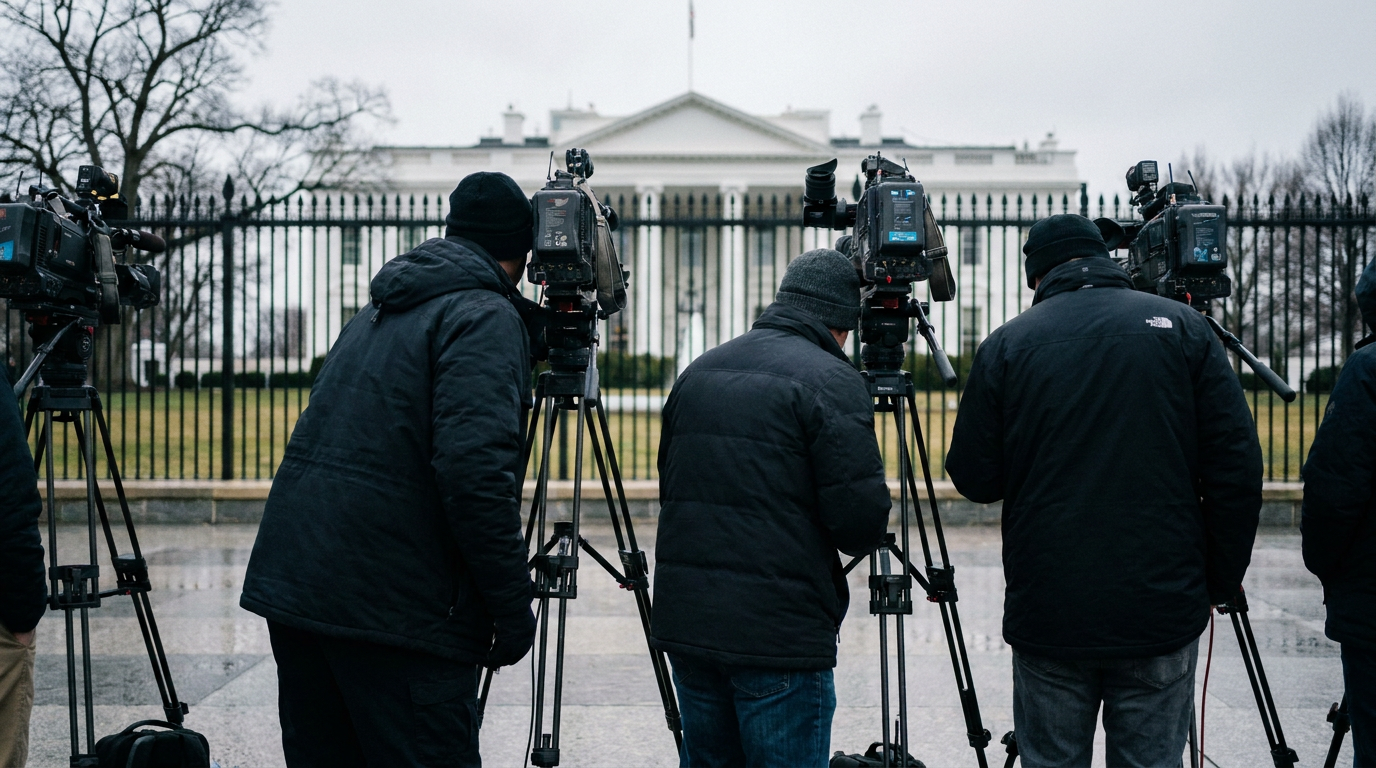
The US Department of Justice is examining whether five television networks breached competition law by jointly suspending White House pool coverage of President Donald Trump after his administration excluded three news organisations.
ABC, CBS, CNN, NBC and Fox News have been asked to provide communications concerning the pool. The department is considering the suspension under the Sherman Act, a federal law addressing anti-competitive conduct, including certain agreements between rival businesses.
The investigation, confirmed by a department spokesperson on Saturday, follows a dispute over journalists’ access to the president. On 19 September, the White House withdrew credentials from reporters working for CNN, MS Now and Politico, preventing them from entering the building.
The five television pool members then stopped providing their shared presidential coverage for several days. Their action concerned the collective arrangement through which broadcasters obtain and distribute pictures of the president, rather than a decision by the entire news industry to stop reporting on him.
CNN, MS Now and Politico challenged their exclusion in court. A judge granted temporary relief, and the White House restored their access. The television pool has also returned to work. The court protection for the three organisations runs until Tuesday.
Pool arrangements allow a small group of journalists to cover events on behalf of a much larger press corps. They are particularly important when the location cannot accommodate every organisation seeking to attend, making the participating journalists’ material useful well beyond their own audiences.
The television participants rotate responsibility for organising coverage, divide its costs and distribute footage to other outlets across the United States. That combination of editorial activity and co-operation between commercial competitors is central to the dispute now facing the broadcasters.
The background
The September exclusions followed Trump’s accusations that CNN, MS Now and Politico had published false accounts about his administration. The organisations’ legal challenge argued that withdrawing access infringed the constitutional protection afforded to the press.
The First Amendment limits the government’s power to interfere with freedom of speech and journalism. Courts have generally understood its press protections to prohibit officials from treating news organisations differently because they dislike the content of their reporting.
That principle distinguishes a dispute about limited physical space from one about editorial viewpoint. Organising access to a crowded room involves practical restrictions; using a news outlet’s coverage as the reason to exclude it raises a separate constitutional question.
Control of the pool had already changed in February, when the White House announced that it would decide its composition. The White House Correspondents’ Association had overseen the arrangement for more than a century, placing those decisions with a journalists’ organisation rather than the administration being covered.
Another access battle began that month when the administration restricted Associated Press reporters and photographers from areas with limited capacity, including the Oval Office and Air Force One. The dispute concerned the agency’s continued use of Gulf of Mexico rather than Gulf of America.
Associated Press brought its own lawsuit, which remains ongoing. Its case involves different restrictions from those imposed on the three organisations in September, although both concern the relationship between editorial decisions and physical access to presidential events.
The administration has also pursued legal action against US news publications over their coverage of Trump. The pool inquiry introduces competition enforcement into that wider conflict, alongside litigation about access and challenges to published journalism.
Antitrust law examines how businesses behave in markets. Rival companies may sometimes co-operate legitimately, but agreements that suppress competition can attract scrutiny. A shared production arrangement and a collective refusal to provide a service therefore raise different questions, even when they involve the same participants.
What people are saying
The justice department’s spokesperson said the Antitrust Division was examining whether the news organisations’ conduct broke competition law. The department’s stated concern is that a collective boycott by competing businesses can fall foul of federal rules.
That position focuses on the networks’ joint action rather than the accuracy or tone of any individual broadcast. It places the decision to suspend pool operations under the legal framework governing commercial behaviour between competitors.
The White House defended its September restrictions by presenting presidential access as a privilege rather than an entitlement. The excluded organisations took the opposite position in their lawsuit, arguing that the administration’s actions violated their First Amendment rights.
Jose Zamora, the Committee to Protect Journalists’ regional director for the Americas, criticised the investigation on Saturday. In a post on X, he argued that competition inquiries should not be used to pressure newsrooms defending access and linked journalists’ ability to attend events to the public’s ability to obtain information.
The five television networks have not commented on the investigation. The public positions so far therefore set out two distinct concerns: the department’s objection to potentially anti-competitive collective action and the press-freedom group’s objection to government pressure on journalists.
What happens next
The department’s request for communications puts the arrangements behind the suspension at the centre of its inquiry. In competition investigations, exchanges between businesses can help establish whether they reached an agreement, what it covered and how participants intended it to work.
Under the Sherman Act, the legal assessment of joint conduct depends on its character and circumstances. Co-operation does not automatically establish an unlawful restraint of trade, and describing an action as a boycott does not by itself resolve the legal question.
The broadcasters’ access dispute follows a separate timetable. Tuesday is the next established point in that process because the temporary protection granted to CNN, MS Now and Politico extends to then. Temporary court relief governs the immediate position while litigation proceeds; it is distinct from a final judgment on the underlying claims.
The two proceedings also examine different decisions. The access case concerns the government’s treatment of news organisations, while the antitrust inquiry concerns the broadcasters’ response. A constitutional argument about exclusion and a competition argument about collective action require different legal tests.
Why this matters
For UK audiences, presidential pool coverage helps make events in Washington visible beyond the small number of journalists admitted to the room. Sharing material allows news organisations that are not physically present to show what happened, rather than relying entirely on an official account. Restrictions affecting that system therefore concern the route by which international news reaches viewers as well as the organisations directly involved.
The dispute also illustrates why shared reporting arrangements matter commercially. Sending separate crews to every presidential event would duplicate work and increase demands on limited space; pooling spreads those tasks and costs. The practical issue is how competing broadcasters can preserve that useful co-operation while complying with competition rules and contesting government restrictions on press access.
Reporting that informed this story
- BBC News: US justice department investigates TV networks over Trump pool coverage
- The Guardian UK: US justice department investigating TV networks over Trump pool coverage
This article was written independently by The Daily Times from publicly available facts and headlines. No text has been copied from the outlets above.