Trump praises police after five arrests near RAF Fairford
Police are examining a possible Iranian link after five men were arrested near RAF Fairford and viable incendiary devices were found in a van.
By Marcus Odell, Political Correspondent
Published 27 Sept 2026, 18:00
What happened
Donald Trump has praised British police after five men were arrested near RAF Fairford in Gloucestershire over a suspected terrorist plot targeting American forces. Counter-terrorism officers are examining whether there was a connection to Iran.
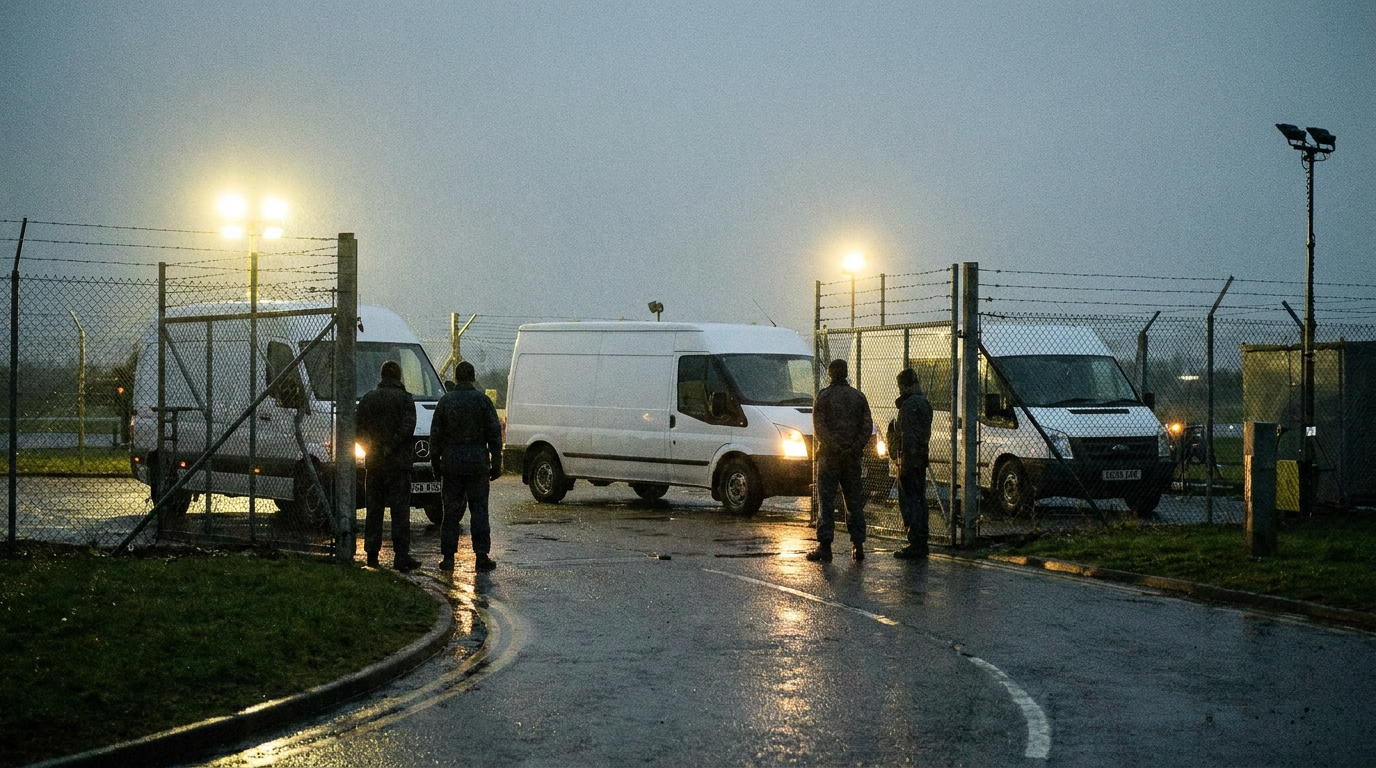
The alarm was raised at about 12.45am when a local resident called 999 after noticing suspicious activity around three white vans near the air base perimeter. The arrests were not believed to have resulted from a planned police operation.
Police said one of the vehicles contained viable incendiary devices and chemicals. Around 85 nearby homes were evacuated, bringing the security incident into the surrounding Cotswolds communities as officers dealt with the suspected threat.
A local farmer who raised the alarm had been returning from a party. She described seeing men moving through trees, with some wearing masks or balaclavas. As her vehicle passed, some headed into fields and others moved towards the base.
Trump, speaking to journalists in Illinois, said the men had intended to inflict serious damage on US forces. He also suggested that the suspects had been watched before their arrest, presenting the response as a successful example of British-American co-operation.
His account of advance surveillance differs from the understanding that the arrests were not pre-planned. Whether the response was triggered by the emergency call or involved earlier investigative work is a distinct issue from the evidence recovered at the scene.
The background
RAF Fairford serves as a US Air Force command outpost for operations from Europe. Its role places an installation in rural Gloucestershire within the wider network supporting American military activity beyond Britain.
The base has been used for US strikes against Iranian missile sites involved in attacks on shipping in the Strait of Hormuz. Those operations connect Fairford directly to the confrontation involving Iran and a strategically important route for international maritime trade.
In July, Iran’s Revolutionary Guard warned Britain against allowing American bombers to operate from Fairford. That warning forms part of the background to the investigation, but a previous threat and responsibility for a particular suspected offence are separate matters.
The arrests also come amid concern about hostile states using other people to carry out crimes in Britain. Russia is among the states that have used such proxies on British soil. A proxy acts on behalf of another party rather than openly as its representative.
In an investigation involving possible state connections, establishing what individuals did is only one task. Investigators may also need to examine whether someone else supplied instructions, money or practical assistance. Those are different forms of involvement and require evidence linking the parties concerned.
An incendiary device is intended to start a fire. The description differs from an explosive device, whose principal effect is a blast. Police described the items recovered at Fairford as viable incendiary devices; that terminology should not be treated as proof of a particular delivery method.
What people are saying
Trump thanked the British authorities and described their work with the United States in strongly positive terms. His remarks emphasised the protection of American personnel and the value of the two countries working together on security threats.
The president was less definite about which British organisation had been involved. He mentioned Scotland Yard as a possibility rather than identifying it with certainty. His comments therefore did not amount to a clear account of which force carried out each part of the operation.
Defence Secretary Wes Streeting praised the response of the security services while speaking at a Labour Party conference fringe event in Liverpool. He placed the incident within their wider work protecting the public, including duties performed outside normal hours and beyond the UK.
Asked about possible Iranian involvement, Streeting declined to discuss the suspects’ motivations or how their alleged activity had originated. He said it was too early to speculate, keeping his assessment of the response separate from any attribution of responsibility.
Streeting also said Britain had been working closely with the United States and that he had spoken to his American counterpart, Pete Hegseth, that day. The contact brought the incident into discussions between the two governments at defence secretary level.
What happens next
The investigation concerns both the suspected activity around Fairford and the possible Iranian connection. Establishing a link to a foreign state is an evidential question: the location of an incident or the nationality attributed to a suspect does not, by itself, establish who directed it.
Forensic examination can help establish the composition and functioning of recovered devices. In cases involving several vehicles and several suspects, investigators must also distinguish between where an item was found, who had access to it and who was responsible for it.
The distinction matters because criminal responsibility is individual. The arrest of five people together does not establish that each had the same role or knowledge. Any prosecution must address the alleged conduct of each defendant rather than treating the group as a single legal entity.
An arrest allows police to investigate a suspected offence; it is not a finding of guilt. In England and Wales, terrorism charging decisions are generally made by the Crown Prosecution Service, applying legal tests to the evidence and considering whether a prosecution is in the public interest.
For most charging decisions, prosecutors assess whether the evidence offers a realistic prospect of conviction. A separate, tightly defined threshold test can be used in some cases where further evidence is expected and the circumstances justify an immediate charging decision.
Terrorism law provides special arrangements for detention before charge. Under the Terrorism Act framework, detention can extend to a maximum of 14 days, with judicial authorisation required beyond the initial period. That is a legal ceiling, not an automatic length of custody for every suspect.
If charges lead to a trial, the prosecution must prove its case so that the court is sure of guilt. Political assessments of the seriousness of an alleged plot do not replace that requirement, and defendants retain the right to challenge the evidence against them.
Why this matters
For people living beside military installations, emergency precautions can affect access to their homes even when the suspected target is inside a base. The Fairford evacuation illustrates how the response to a potential threat can extend beyond a military perimeter into civilian neighbourhoods.
For the wider UK public, the incident also highlights the practical role of emergency reporting. Anyone who sees activity suggesting an immediate danger should call 999, keep a safe distance and avoid approaching suspicious vehicles or handling unfamiliar objects, leaving assessment and intervention to the emergency services.
Reporting that informed this story
This article was written independently by The Daily Times from publicly available facts and headlines. No text has been copied from the outlets above.