Houthis claim Riyadh attack as fire disrupts airport flights
A fuel tank burned near Riyadh’s international airport after air raid alerts, as Yemen’s Houthis claimed attacks on the Saudi capital and Red Sea energy sites.

By Robert Aldridge, Senior Reporter
Published 19 Sept 2026, 18:01
What happened
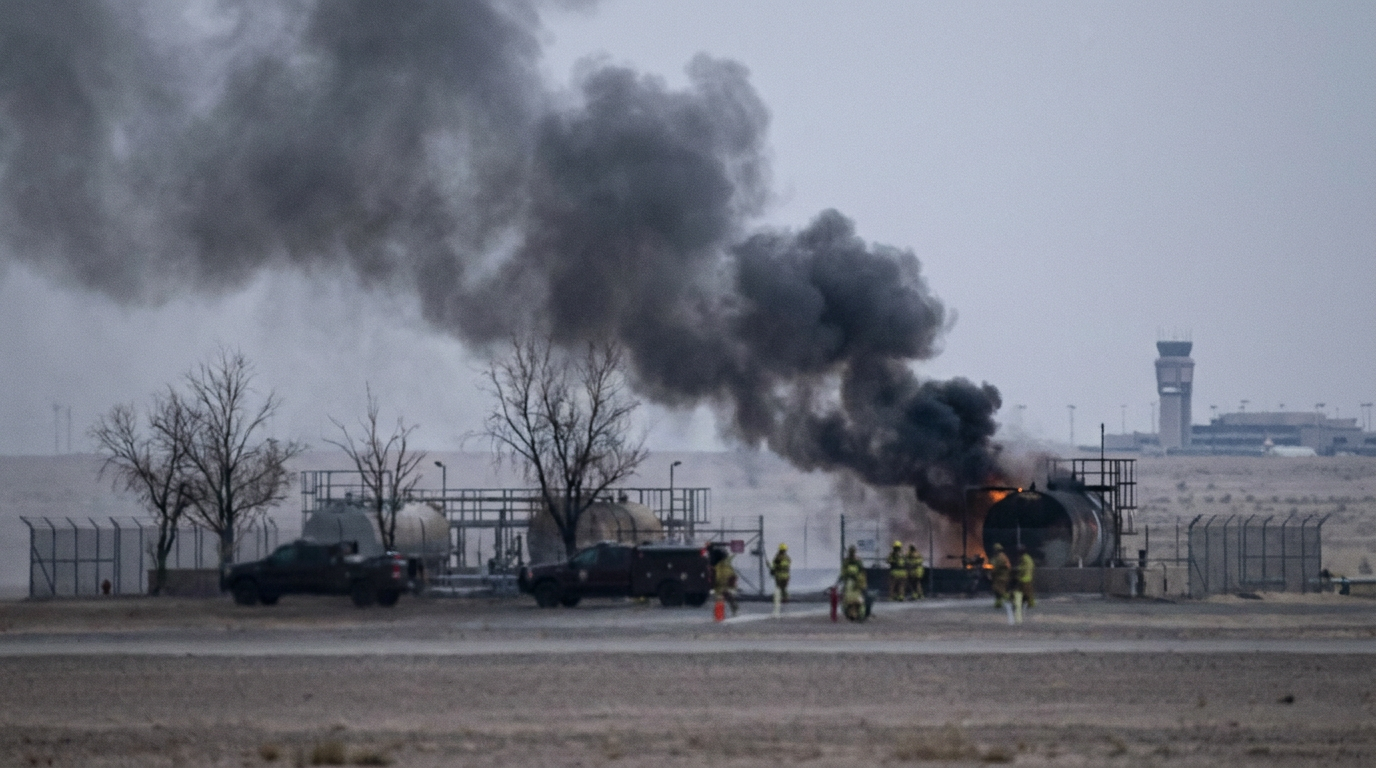
Flights at King Khalid International Airport in Riyadh suffered hours of disruption on Saturday as a fire burned at a nearby fuel storage site. Yemen’s Houthi movement said it had attacked the Saudi capital and energy facilities on the country’s Red Sea coast with missiles and drones.
Flames and dense black smoke rose from the depot near the airport. Firefighters worked to extinguish a burning fuel tank belonging to Aramco, Saudi Arabia’s state oil and gas company, while apparent explosions were heard in the capital.
The flight-tracking service FlightRadar24 recorded delays and cancellations and placed the airport at the highest level of its disruption index. That measure describes disruption to flight operations; it is separate from the emergency warnings sent to people on the ground.
Houthi military spokesman Yahya al-Sarea said the operation involved ballistic missiles, cruise missiles and drones. He identified targets in Riyadh and Aramco facilities at Yanbu, an industrial port on the Red Sea. Saudi authorities have not commented on the claimed attacks.
Saudi Civil Defence issued telephone alerts overnight on Friday for Riyadh, Jeddah, Yanbu and other areas, warning of possible aerial attacks. People were told to remain indoors. The warnings therefore extended beyond the capital to cities on the kingdom’s western coast.
An all-clear followed, and authorities also urged residents to avoid gathering in crowds. People in Riyadh described further apparent explosions after the initial alerts. One resident in the north of the city said the noise was strong enough to shake the windows of their home.
The background
The alerts were the first issued to Riyadh residents since fighting between Saudi Arabia and the Iran-backed Houthis intensified in July. The movement has attacked Saudi targets repeatedly in recent months, bringing the effects of Yemen’s conflict across the border into the neighbouring kingdom.
Inside Yemen, the Houthis are fighting the internationally recognised government, which Saudi Arabia supports. That alignment places Saudi Arabia both behind one side of the civil war and among the targets of Houthi military operations beyond Yemen’s territory.
Al-Sarea presented the latest operation as retaliation for Saudi attempts to strike Sanaa, the Yemeni capital. Earlier, he accused Saudi Arabia of carrying out 300 strikes across Yemen in the preceding week. Those figures and the stated reason for the attack were the Houthi movement’s account.
The group also said during the week that it had brought down a Saudi fighter aircraft over Yemen. That claim concerned the air campaign, while the latest attacks on Riyadh and the coast extended the confrontation to urban and energy infrastructure inside Saudi Arabia.
Recent fighting has forced almost 105,000 people from their homes in Yemen, according to the International Organization for Migration, a United Nations agency. Displacement adds a civilian dimension to the military struggle: people leaving their homes must also find somewhere to live while fighting continues.
The shipping routes at risk
The Houthis’ recent territorial gains include Mokha, a strategically important Yemeni port, and Perim Island, which they captured earlier this month. Perim lies in the Bab al-Mandab strait, a gateway on the shipping route linking the Red Sea with waters to its south.
The movement has also taken control of Greater Hanish and Lesser Hanish, islands in the Red Sea. Together, the coastal and island gains give the conflict a maritime dimension, alongside the ground fighting in Yemen and the use of aircraft, missiles and drones.
The Houthis describe their naval blockade as a response to Saudi restrictions on ports and airports in north-western Yemen under their control. The confrontation therefore involves access both to Houthi-held territory and to a sea route used for Saudi exports to Europe and Asia.
Saudi vessels have depended on that Red Sea route for oil exports since the war involving the United States, Israel and Iran effectively closed the Strait of Hormuz. Disruption at one passage has consequently increased the importance of another that is now exposed to the conflict in Yemen.
Yanbu’s role as an industrial port with major oil facilities makes the claimed targeting of the city significant beyond its immediate surroundings. The risks concern both fixed infrastructure on the coast and the onward movement of exports through the shipping corridor.
What people are saying
On Friday, before the airport fire, the United Nations Security Council condemned continuing Houthi attacks on Saudi Arabia. Its statement said earlier attacks had affected civilian and energy infrastructure and injured civilians, including women and children. Those remarks concerned the broader campaign, rather than Saturday’s incident.
The council also condemned the Houthi military offensive inside Yemen. Its intervention addressed both fronts of the escalation: cross-border attacks against Saudi Arabia and military advances within the country where the civil war is being fought.
All 15 council members called for countries to work together to prevent the movement obtaining weapons, military training, finance and other assistance supporting its attacks. Their position focused on the resources sustaining the campaign, rather than only on individual launches or targets.
The investment bank JP Morgan highlighted the difficulty of assessing the oil-market consequences on Friday. In a note to investors, it said it could not model how the war would end. The warning underlined uncertainty about the conflict’s eventual shape, rather than offering a firm forecast for oil prices.
What happens next
The Security Council stressed that every country must enforce the United Nations arms embargo against the Houthis. Its call for practical cooperation places the emphasis on implementation: preventing prohibited supplies and support from reaching the movement, as well as condemning attacks after they happen.
An arms embargo is a restriction on military supply, not an agreement to stop fighting. The council’s demands therefore concern how governments constrain the Houthis’ access to equipment and assistance; they do not themselves settle the military confrontation in Yemen or across the Saudi border.
For passengers with journeys through Riyadh, individual flight arrangements are the immediate practical issue. A citywide all-clear and an airport’s operating position answer different questions. Travellers should check their airline’s departure and connection information before setting out, particularly where a delay could affect an onward journey.
Why this matters
For UK travellers using Riyadh, disruption can affect more than the flight departing from the Saudi capital. A cancelled or delayed connection may change the rest of an itinerary, making the status of each booked leg important rather than simply whether the airport is operating.
For UK households and businesses, the wider exposure is through internationally traded energy and shipping. Threats to export facilities and sea passages can put pressure on supply routes, but a claimed attack is not itself a measure of lost oil production or a prediction of what consumers will pay.
Reporting that informed this story
- BBC News: Houthis claim attack on Saudi capital after smoke seen rising near Riyadh airport
- The Guardian UK: Thick smoke seen near Riyadh airport after air raid alerts in Saudi capital
This article was written independently by The Daily Times from publicly available facts and headlines. No text has been copied from the outlets above.