US sends third aircraft carrier towards Middle East amid Iran war
More than 9,000 sailors and Marines are heading to the region as Donald Trump raises the possibility of further strikes after the US midterm elections.

By James Reeve, Foreign Affairs Writer
Published 2 Oct 2026, 07:01
What happened
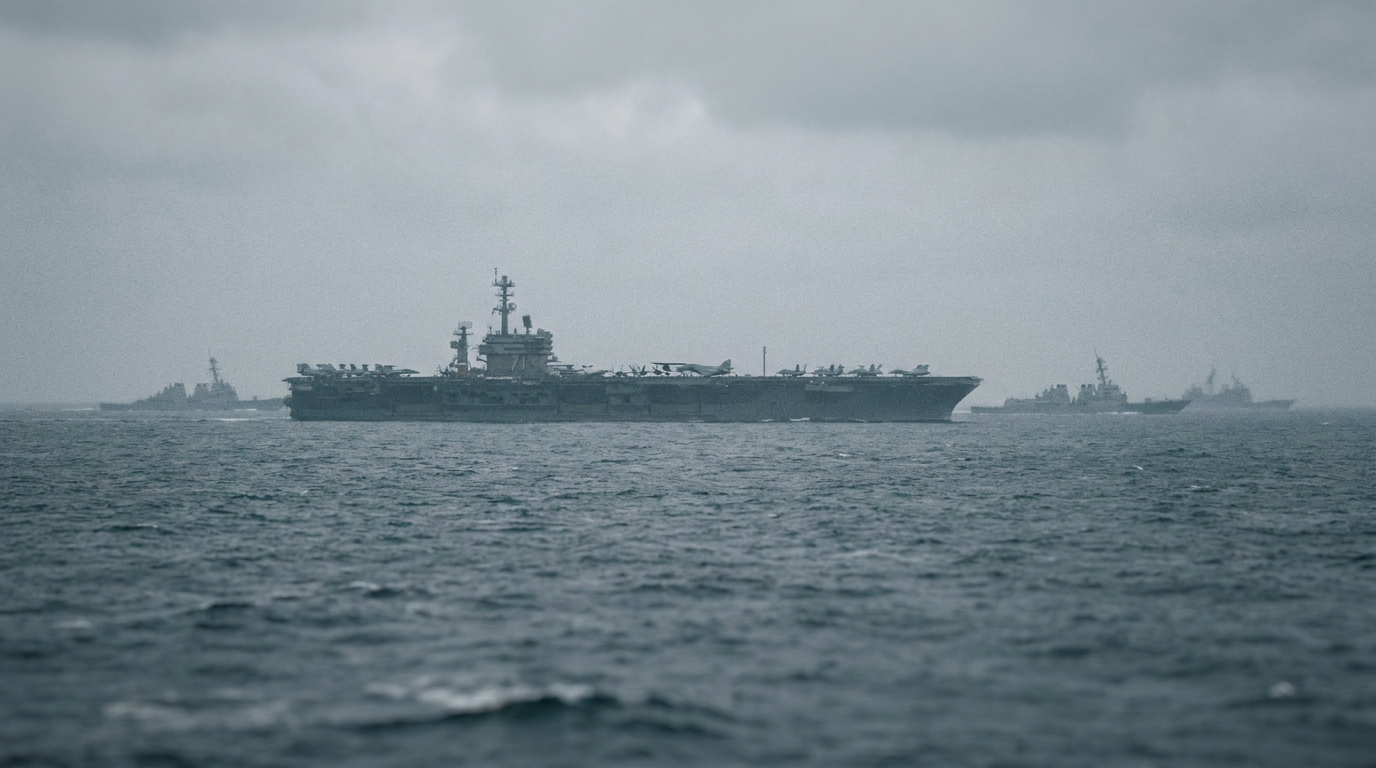
The United States is sending the USS Theodore Roosevelt and an amphibious naval force towards the Middle East, potentially putting three American aircraft carriers in the region by the end of October as President Donald Trump considers further attacks on Iran.
More than 7,000 sailors and 2,000 Marines are aboard the incoming ships. Their arrival would take the American naval force in the region above 20,000 personnel, alongside hundreds of aircraft, at a time when the war and its political consequences are approaching another US electoral test.
The Roosevelt carrier strike group includes the cruiser USS Chosin. Travelling to the region separately as part of the reinforcement is the USS Makin Island amphibious readiness group, which includes the amphibious landing ships USS John P. Murtha and USS Anchorage.
Two carriers, USS George H.W. Bush and USS George Washington, are already operating in the Middle East. The USS Boxer amphibious readiness group is also there. An American official said the additional carrier could reach the region early enough for all three to be present before October ends.
That overlap could be temporary. Once the Roosevelt arrives, the Washington could head towards waters off Japan. The movement therefore involves both an increase in forces available in the Middle East and the possibility of a subsequent transfer back towards the Pacific.
The deployment brings together two different kinds of naval capability. Aircraft carriers provide a mobile base for aviation, while amphibious groups transport Marines and equipment and can support operations between ships and shore. Sending both gives military commanders a broader range of options than a carrier deployment alone.
Their presence does not itself amount to an order to attack. Moving a naval force places personnel and equipment within reach of a theatre of operations; authorising a particular strike or landing is a separate decision.
The background
The US Navy last had three carrier strike groups in the Middle East in April. That was the first such concentration there since 2003, illustrating how unusual it is to commit that many of its carrier formations to the region at once.
The Washington normally operates in the Pacific. It moved to the Middle East to replace USS Abraham Lincoln, whose crew had spent more than 260 consecutive days at sea during an extended deployment. The potential move towards Japan would take the Washington back towards its usual operating area.
Carrier rotations matter beyond the number of ships visible in one region. A formation arriving to relieve another can briefly create a larger force, while also allowing the outgoing ship and its crew to leave. The duration of any overlap determines how long that additional capacity remains available.
The war has also outlasted Trump's initial suggestion that it would take only weeks. It is now approaching the 3 November midterm elections, bringing the conduct of the conflict into the same political calendar as contests that will determine the balance of power in Congress.
Midterm elections occur halfway through a president's four-year term. Voters choose the entire House of Representatives and roughly a third of the Senate. Control of those chambers affects legislation, federal spending and congressional scrutiny of an administration, including its handling of military operations.
Diplomacy remains tied to access through the Strait of Hormuz, a major route for energy shipments. Trump has rejected Iran's latest ceasefire proposal, which included an offer to reopen the waterway. He said the wider package did not meet his requirements.
The strait connects the Gulf with the Gulf of Oman and the Arabian Sea. Its geography concentrates maritime traffic through a narrow passage, making access important not only to the countries on its shores but also to energy buyers and shipping businesses farther afield.
What people are saying
In an interview conducted on Monday and published on Thursday, Trump said he could intensify bombing against Iran after the midterm elections. He declined to describe potential targets or give further operational details when asked about his strategy.
Asked whether the war could damage Republican prospects in November, he initially accepted that possibility. He then argued that preventing Iran from possessing a nuclear weapon could help his party, presenting the political effect as dependent on how voters understood the purpose of the conflict.
A separate warning followed Wednesday's attack aboard an Israel-bound FlyDubai flight. The co-pilot stabbed the captain and tried to crash the aircraft. Speaking to reporters on Thursday, Trump said early indications pointed towards a connection between the suspect and Iran or the Islamic Revolutionary Guard Corps.
Trump made retaliation conditional on establishing that connection. He said the United States would respond forcefully against Iran if investigators found that it had backed the attack. His remarks placed the aviation investigation alongside the ceasefire dispute as another potential trigger for American action.
Israeli Prime Minister Benjamin Netanyahu also addressed the suspect on Thursday. He said investigators believed the co-pilot had undergone radical Islamist indoctrination. That allegation concerns the suspect's ideological influences; Trump's warning concerned the separate question of Iranian involvement and possible state responsibility.
What happens next
The immediate military milestone is the arrival of the Roosevelt group. Its timing, together with any departure by the Washington, will determine whether the United States again has three carriers operating in the Middle East simultaneously and how long that concentration lasts.
Keeping several naval groups in one theatre also involves continuing support at sea. Ships need fuel, food, spare parts and maintenance, while embarked aircraft require their own supplies and servicing. These demands help explain why deployments involve supporting vessels and rotation arrangements rather than aircraft carriers operating in isolation.
The election provides a political marker, not an automatic military timetable. Trump's comments leave an escalation after 3 November as an option rather than a declared operation. The distinction matters because a possible course of action and a decision to execute it are different stages of military planning.
Investigators' findings about the FlyDubai suspect could also affect the administration's choices. Trump's stated condition for retaliation is a link to Iranian backing, making that question relevant to whether the aircraft attack becomes a further confrontation between Washington and Tehran.
Why this matters
For UK households and businesses, the Strait of Hormuz connects this conflict to the cost and reliability of energy supplies. Disruption to shipping can affect international markets, freight costs and insurance, with consequences extending beyond countries that buy energy directly from Gulf producers.
The naval movements also show how a prolonged Middle East commitment can draw American forces away from other regions. For Britain, a US ally, that wider distribution matters to defence planning: the Washington's possible return towards Japan would be a redeployment between theatres, not simply the end of a mission.
Reporting that informed this story
- Daily Mail: US to deploy third aircraft carrier and 10,000 more troops to Middle East as Trump considers strikes on Iran
- The Guardian UK: US sends third aircraft carrier to Middle East amid stalemate in Iran war
This article was written independently by The Daily Times from publicly available facts and headlines. No text has been copied from the outlets above.